


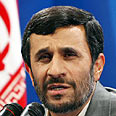
Ahmadinejad furious over Israel-Syria talks
Sources close to Iranian president tell London-based al-Sharq al-Awsat newspaper he did not hide discontent, amazement after being informed of negotiations between Damascus, Jerusalem. 'This is a violation of the mutual commitments between the two countries, and Tehran will prepare an appropriate response,' source says
According to sources close to Iranian President Mahmoud Ahmadinejad, the latter did not hide his discontent and amazement after receiving detailed information on the secret talks held between Syria and Israel.
This took place only several weeks after Syrian Foreign Minister Walid Moallem paid a visit to Tehran, during which Ahmadinejad attempted to strengthen the "bear hug" around Syria's neck.
The Iranian leader warned Moallem and the moderate Arab states that whoever will join the United States will be doomed along with Washington.
A source noted that Ahmadinejad referred to the developments as "a Damascus violation of the mutual commitments between Syria and Iran."
It was also reported that the Iranian Supreme National Security Council will look into the message relayed by Damascus in regards to its talks with Israel, in order "to prepare an appropriate response."
On Thursday, Damascus rejected Foreign Minister Tzipi Livni's demand that Syria distance itself from terror organizations, including Hamas and Hizbullah. Syrian Information Minister Muhsin Bilal said that "when they make these demands, they are setting conditions and the issue of peace, the peace process does not require prior conditions."
Following the publication of the Israel-Syria talks Wednesday, Prime Minister Ehud Olmert said he had no illusions regarding the negotiations with Damascus.
"The negotiations will not be easy or simple and the process will involve difficult concessions," he said during an event at the Kibbutz College of Education, adding however that "in situations like this it is always better to talk than to shoot and I am happy both sides here have decided to talk."
