


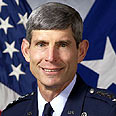
Norton Schwartz
צילום: AP
Gates recommends Schwartz to head Air Force
Jewish commander of US Transportation Command recommended by defense secretary to become next air force chief. 'I believed that we needed a change of leadership to bring a new perspective,' Gates says
Defense Secretary Robert Gates had recommended that Gen. Norton Schwartz, a 35-year veteran with a background in Air Force special operations, be the next Air Force chief.
In a sweeping shake up of the Air Force, Gates also formally sent former Air Force official Michael Donley's name to the White House to be the next secretary of the beleaguered service.
Gates announced last Thursday that he was removing Air Force Gen. Michael Moseley, from the chief's job and Michael Wynne as its top civilian. Gates held them accountable for failing to fully correct an erosion of nuclear-related performance standards.
Schwartz has been commander of the US Transportation Command since September 2005.
A senior defense official had said last week that Gates was likely to choose Donley, the head of the Pentagon's management office, to replace Wynne. Donley served as acting Air Force secretary for seven months in 1993.
Seeking to underscore the depth of his concern about weaknesses in Air Force leadership, Gates was planning to visit Langley Air Force Base, Va., on Monday to address airmen. He was expected to stress the importance of leadership accountability and emphasize that despite his well-publicized tensions with the Air Force, he strongly supports the service and appreciates its many wartime contributions.
'We needed a change of leadership'
On Tuesday he plans to make similar speeches at Peterson Air Force Base, Colo., home of Air Force Space Command, which has responsibility for the service's nuclear intercontinental ballistic missile force, and at Scott Air Force Base, Ill., home of Air Mobility Command, whose tanker refueling aircraft are part of the nuclear bomber mission.
When he announced last Thursday that he was removing Wynne and Moseley, Gates expressed disappointment that shortcomings in the Air Force's handling of its nuclear mission had been allowed to persist.
"I believed that we needed a change of leadership to bring a new perspective and to especially underscore the importance of accountability in dealing with these kinds of problems," Gates told reporters Thursday.
He said at the time that his decision was based mainly on the damning conclusions of an internal report on the mistaken shipment to Taiwan of four Air Force fusing devices for ballistic missile nuclear warheads. And he linked the underlying causes of that slip-up to another startling incident: the North Dakota-to-Louisiana flight last August of a B-52 bomber that was mistakenly armed with six nuclear-tipped cruise missiles.
The report asserted that slippage in the Air Force's nuclear standards was a "problem that has been identified but not effectively addressed for over a decade."
Gates said the Taiwan mistake did not compromise US nuclear weapons technology and did not pose a physical danger, but it "raised questions in the minds of the public as well as internationally."
