


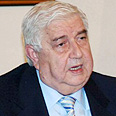
Denies nuclear program. Moualem
צילום: איי אף פי
Syrian minister laments Israel's nuclear edge
FM Moualem says wishes his country could match Israel's atomic arsenal 'quite simply because Israel has made huge advances in its manufacturing of nuclear bombs'
Syria's foreign minister said on Monday he wished his country could match Israel's atomic arsenal, but denied US allegations that it had been building a secret nuclear reactor at a site bombed by Israel last year.
Walid Moualem, making Syria's first official comments on last week's visit to the site by UN nuclear investigators, said it had been handled solely by Syrian security officials.
"Syria would not have allowed the inspectors in if it had such a secret (nuclear) program," Moualem told reporters in Damascus after meeting his Norwegian counterpart, Jonas Gahr Stoere.
"As a private citizen, I wish Syria had this program quite simply because Israel has made huge advances in its manufacturing of nuclear bombs," the foreign minister said.
Syria has accused the United States of helping Israel conduct the September 6 raid that Washington said destroyed a reactor built with the help of North Korea. Syria said the site was a normal military complex. Israeli officials have kept quiet on the nature of the target.
Unlike Syria, Israel has not signed the Non-Proliferation Treaty. It is widely believed to have the only nuclear arsenal in the Middle East, developed over decades with Western help.
Investigators from the International Atomic Energy Agency (IAEA) said after a four-day visit to Syria last week that they had examined the bombed site, but that more checks were needed.
Chief inspector Olli Heinonen said the inquiry was off to a good start, with Syria's cooperation satisfactory so far.
'Opportunity to reach just, comprehensive peace'
Syria said it was not hiding anything and urged the world to hold Israel accountable for what it described as a massive Israeli nuclear arms program.
The IAEA sent Heinonen's team after receiving US photos of the al-Kibar site that prompted the U.N. nuclear watchdog to put Syria on its proliferation watch list in April.
The IAEA inspectorate is expected to report to the agency's board of governors before its next meeting in September.
Syria and Israel began indirect peace talks months after the raid. Moualem said the Turkish-mediated talks had their "ups and downs" but he expected a third round of negotiations to take place in Turkey soon.
"The present negotiations process aims at establishing the basis to launch direct talks. We have an opportunity to reach a just and comprehensive peace. I hope the Israelis do not waste it by their internal wrangling," Moualem said.
Divisions appeared in Israel's ruling coalition last month with the launch of a police investigation into money that Prime Minister Ehud Olmert received from an American financier while in previous government positions.
Syria is demanding Israel returns all of the Golan Heights, which Israel captured from Syria in the Middle East war 41 years ago. Israeli officials have said a peace deal depends on Damascus distancing itself from Iran and cutting links to groups such as Hamas and Lebanon's Hizbullah.
