


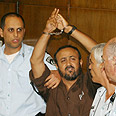
Marwan Barghouti
צילום: יריב כץ
Barghouti spin highlights faults in Mideast media
'Israeli-Arab conflict has too many emotional, nationalistic and religious elements for the media to maintain neutrality,' expert says
Contradictory reports in the Israeli and Palestinian media are placing question marks over the reliability of the Middle Eastern media.
Reports are abounding regarding the inclusion of two senior jailed Palestinians in a possible deal to release Israel soldier Gilad Shalit from captivity in Gaza.
One is Marwan Barghouti, a senior Fatah member, who is serving five consecutive life terms in an Israeli jail for his involvement in terrorism.
The other is Ahmad Sa’dat, who heads the Popular Front for the Liberation of Palestine (PFLP), and who is in jail in connection with the assassination of Israeli Tourism Minister Rehavam Zeevi in 2001.
The London-based Al-Quds Al-Arabi quoted Palestinian sources as saying that a prisoner exchange deal between Israel and Hamas, brokered by Egypt, would include both Barghouti and Sa’dat.
The Emirates-based Al-Bayan said Sa’dat’s release was still being considered, and the London-based Al-Hayyat quoted a “reliable Egyptian source” as saying Israel had agreed to release Barghouti, or Sa’dat, or both.
Israel is not confirming the reports.
A separate report in the Palestinian Ma’an News Agency said Palestinians had found a projectile south of Nablus and accused Israelis in post-1967 Jewish communities of firing rockets onto their communities.
Israel denied these rockets had been fired by Israelis.
But beyond the veracity of the reports themselves, the explosion of information and often-conflicting reports in the Middle East media sometimes confuse the media consumers more than informing them.
The Israeli media and the Palestinian media are very different and are by no way symmetrical, says Yizhar Be’er, executive director of the Keshev Center for the Protection of Democracy in Israel.
'There are signs of journalistic work'
The Palestinian media tend to be less independent and are often politically aligned, Be’er explains.
“The Israeli media are more professional, freer and more pluralistic and have no formal censorship except for specific security matters,” Be’er says.
“But there are gaps between the information that the reporters send and the end result after the editorial work. We see the editors frame the reports in a way that highlights the responsibility of the Palestinians and downplays the Israeli responsibility. The main narrative is that the other side is to blame for the situation we’re in.”
Be’er is of the opinion that there is no such thing as objective media. This is especially pertinent to the Middle East, where the Israeli-Arab conflict has too many emotional, nationalistic and religious elements for the media to maintain neutrality.
Ruham Nimri, coordinator of the media-monitoring unit at the Palestinian Miftah organization, says the Palestinian media are still taking baby steps and have not reached a decent level of professionalism.
“The problem with the Palestinian media is that they don’t have their own reporting,” Nimri says. “What you read in the Palestinian papers is news taken from Israeli sources and international agencies, so there’s nothing much new when you read a Palestinian newspaper.”
The pan-Arab papers, such as those based in London, tend to be more reliable and serious, Nimri says.
Regarding the conflicting reports on Barghouti, Be’er says he does not think anyone really knows what is happening.
“There are a lot of media spins all the time. When you don’t really know the facts you write what you want.”
Because of the fierce competition in the media today, no media outlet can afford not to write anything and lag behind. This is causing the quality of the media to deteriorate and is making them more sensational, more tabloid and more entertainment-oriented, Be’er believes.
The Arab media, and especially outlets that are national and not pan-Arab, have a propensity to quote unnamed sources, a fact that makes the reports more difficult to verify.
Nimri says this tendency is much more prevalent in country-based media, rather than pan-Arab outlets.
“It’s different being a media outlet in Syria and being in London,” he says.
Journalism in the Middle East in terms of its professionalism and independence stands somewhere between Western journalism and the mouthpiece journalism prevalent in the Communist era, he explains.
“There are signs of journalistic work, but there is still a big gap between free media in the West and the Arab media,” Be’er says.
Article reprinted by permission of The Media Line
