


Report: Torture widespread in Palestinian jails
Human rights groups publish report indicating Hamas, Fatah rivalry in Gaza Strip, West Bank manifests in brutal torture of detainees; more than 1,000 people reporedly detained by each side
Majdi Jabour was beaten to the point of passing out by the Fatah-allied interrogators in the West Bank who accused him of ties to rival Hamas. In Gaza, the same fate befell a Fatah supporter who was bloodied in a lockup by club-wielding Hamas security men.
Two human rights groups on Monday decried widespread mistreatment and torture in Palestinian jails – an issue taking on fresh urgency with a flare-up of Hamas-Fatah violence over the weekend in the Gaza Strip.
Detainees corroborated the reports in conversations with The Associated Press, and a doctor confirmed Jabour's account.
The groups' reports looked at human rights violations during the past year, since the Islamic militant Hamas wrested control of Gaza from the forces of Palestinian President Mahmoud Abbas, who now runs just the West Bank.
In the past year, the security forces in both the West Bank and Gaza have carried out large-scale, arbitrary arrests of political opponents, the Palestinian human rights group Al Haq said in an 85-page report.
More than 1,000 people were detained by each side, Al Haq estimated, even before a roundup of some 200 Fatah supporters in Gaza over the weekend, following a bombing that killed five Hamas activists.
An estimated 20% to 30% of the detainees suffered torture, including severe beatings and being tied up in painful positions, said Al Haq director Shawan Jabarin, citing sworn statements from 150 detainees.
"The use of torture is dramatically up," added Fred Abrahams, a senior researcher for Human Rights Watch, a US-based group that is releasing its own report on abuse later this week.
Human Rights Watch said Abbas' forces need to come under closer scrutiny because of the massive international support they enjoy.
"The international community has pledged $8 billion to the Palestinian Authority in the West Bank and that gives them a heavy responsibility to make sure the security forces don't use torture and respect human rights," said Abrahams.
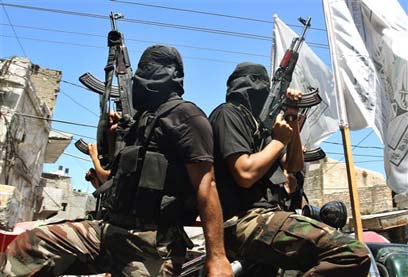
Iron hold. Hamas operatives in Gaza (Photo: AP)
Funding of Abbas' forces should be linked to an improvement in the human rights record, Human Rights Watch said.
Abbas' prime minister, Salam Fayyad, acknowledged "shortcomings," but said human rights violations have decreased. "I'm not defending anyone, but I can assure you that we have treated flaws and don't allow violations. The upcoming reports will be better," Fayyad said.
In Gaza, Hamas spokesman Fawzi Barhoum accused the Fayyad government of trying to destroy Hamas in the West Bank with US backing.
Barhoum acknowledged "mistakes" were made by the Hamas forces, but said that unlike in the West Bank, violators were increasingly punished.
'Systematic abuse'
The Al Haq report described a series of methods used by interrogators in both territories.
Al Haq described the mistreatment as systematic. In the West Bank, most of the abuse was carried out by the Preventive Security Service and the General Intelligence, the rights group said.
In Gaza, the lead was taken by Hamas' Izz al-Din al-Qassam Brigades which have been folded into the security forces, according to Al Haq.
The group said it had confirmed two deaths in detention, one in Gaza last July and one in the West Bank in February. Al Haq said it noted a decline in West Bank abuses in the past three months.
The office of Washington's security envoy in the Palestinian areas, Lt. Gen. Keith Dayton, declined comment on the reports. Dayton leads a US effort to help train and equip Abbas' security forces.
European countries are also sponsoring a program aimed at bolstering a now 900-strong civil police force. An international conference in Berlin in June secured commitments of $242 million for projects to strengthen the Palestinian police and judicial systems.
