


Iran says it put first dummy satellite in orbit
Islamic Republic says it put dummy satellite into orbit on home-grown rocket for first time; technology used to put satellites into space can also be used for launching weapons. Israeli expert: 'Iran far from launching military satellite with real capabilities'
Iran said it had put a dummy satellite into orbit on a home-grown rocket for the first time on Sunday -- a move likely to increase Western concerns about its nuclear ambitions.
The long-range ballistic technology used to put satellites into space can also be used for launching weapons, although Iran says it has no plans to do so.
"The Safir (Ambassador) satellite carrier was launched today and for the first time we successfully launched a dummy satellite into orbit," Reza Taghizadeh, head of the Iranian Aerospace Organization, told state television.
However Israeli expert Yiftah S. Shapir, who heads the Military Balance project at the Institute for National Security Studies (INSS) claims Iran is still far from its goal of launching a real communications satellite into space. "This was a step towards the launching of an Iranian military satellite, but the road is still long," he said.
"Prestige-wise a two-kilogram satellite waving an Iranian flag in space would be enough, but capability-wise, even if the satellite is launched, it will be a tiny research satellite without any real ability." He added that Iran launched a Russian satellite into space in 2005, but it disappeared without a trace.
"For 30 years the Iranians have failed to launch a project that was both commercially and economically successful," Shrir said. "I can only assume it's due to ongoing management and organization difficulties – competing Iranian institutions that inhibit one another."
However Shrir does not doubt Iran's motivation. "The launching of an independent satellite is of great national importance to the Iranians and it is definitely a significant part of their missile plan," he concluded.
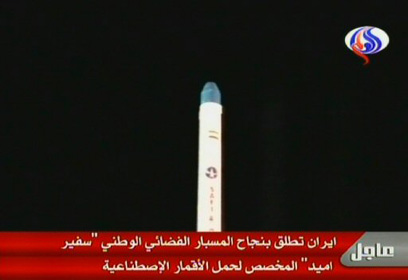
Iran launches dummy satellite. (Photo: AFP)
Iran, embroiled in a standoff with the West over its nuclear ambitions, caused international concern in February by testing another domestically made rocket as part of its satellite program, the Explorer 1.
Iran said at the time it needed two more similar launches before putting a domestically made satellite into orbit. France and Russia both said that test raised the suspicion that Iran was seeking to develop nuclear weapons.
'Sanctions have not isolated us'
Washington, has accused Iran of aiming to equip missiles with nuclear warheads, called it 'unfortunate'. It cites Iran's missile potential, among others, as the reason why it needs to install an anti-missile defense system in eastern Europe.
Iran already claims to have missiles with a range of 2,000 km (1,250 miles), meaning it could hit Israel or US military bases in the Gulf.
The West accuses Iran of trying to obtain nuclear arms under cover of a civilian program. Iran, the world's fourth largest oil producer, insists it needs nuclear technology to generate electricity.
Iranian President Mahmoud Ahmadinejad was present at Iran's space center and read out the launch countdown, state television reported. It said he had "congratulated the Iranian nation on the great achievement."
Iranian television showed the rocket on its desert launch pad, but did not show the actual lift-off. Few details were available about the rocket or its payload.
Western experts say Iran rarely provides enough details for them to determine the extent of its technological advances, but that much Iranian technology consists of modifications of equipment supplied by China, North Korea and others.
The UN Security Council has imposed three rounds of sanctions on Iran for defying demands that it suspend its uranium enrichment program.
Ahmadinejad insisted international sanctions had made Iran even stronger, IRNA reported.
"Sanctions have not isolated us. Instead, we have become more independent," he said after the launch.
Roi Mandel contributed to this report
