


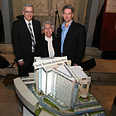
Hospital wing donated by Hadassah
צילום: ענבל רוז
Thank you, donors
Donations by foreigners and locals are making Israel a better country
There are many differences between the National Health Center, considered Georgia’s best hospital, and Israeli hospitals. One of them is the complete absence of plaques bearing the names of donors. There are none on the wall at the entrance, above the doors leading to the various wings, or on the doors to the doctors’ rooms.
The are no plaques not because Georgian donors prefer to donate secretly, but rather, because there is no deep-rooted tradition of donations to public institutions there (with the exception of one institution, the Church, but those donations are made in the hopes of securing a proper reward, either in this world or the afterlife).
It is natural to recall this difference when sitting at the Georgian hospital’s corridor and waiting for an airplane to transport a wounded friend, Yedioth Ahronoth journalist Tzadok Yehezkeli, to Hadassah Ein Kerem hospital in Jerusalem.
Hadassah is considered a high-quality hospital by international standards. Its quality stems from the quality and depth of its medical personnel, but also from the quality and availability of equipment, and from other aspects that cost money. The financial burden is born by the State, as well as by the Hadassah women’s organization in the US, the largest Jewish organization in America. Those donors bring the added value.
Hadassah features numerous plaques glorifying the donors. The initial, very Israeli sense is one of discomfort. Yet then we recall how much life and wellbeing these plaques bought us; it makes us feel like saying just one word to the donors, and particularly the smaller ones – a woman from New Jersey who bought a doorpost; a man from California who commemorated his parents by funding one room – Toda. Thanks.
Ray of light
Any secular person educated in Israel during its first years viewed charity as a Diasporic, parasitic, despicable institution. We despised the pursuit for handouts. We despised the dependence on others. We despised the Talanskys, the “machers”, those wheelers and dealers who got money out of the donors, and the donors who were milked dry.However, only a masochist would enjoy living here without the Jewish National Fund forests, without the university campuses whose construction was funded by Jews from abroad, without the scientific research, the orchestras, the concert halls, the libraries, the parks, and the monuments.
In recent years, Israeli millionaires started internalizing the political and business benefit of donations. The profitable names are Arison, Dankner, and Gaydamak. Corporations have also entered this market. The investment in donations constitutes a ridiculous percentage of their profits, yet delivers great public relations returns.
Yet more interesting are donations made by members of the middle class – donations that are given not in order to get a reward or a plaque. These types of donations show society’s strength and people’s willingness to help each other. There are indications that these donations are on the rise: What is considered obvious within the religious and Orthodox communities, at times to the point of exaggeration, is starting to be internalized by the secular community as well.
And this is nice. With all of the worrisome changes that have taken place in Israel in recent years, this is a ray of light.
