


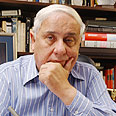
Eitan Haber
צילום: שלום בר טל
Who will pick up that phone?
Do we know enough about Israel's current premiership candidates?
Nine out of every 10 Israelis chuckle when American and Israeli leaders talk about the phone ringing at 3 am and argue over who should be the one to pick it up.
So here's a sad story: On the eve of Yon Kippur, 1973, at 3:45 am – yes, 3:45 am – Israel Lior phoned Golda Meir. The military secretary told the prime minister some hair-raising words, which were forever etched in history: "War will break out today."
Almost 3,000 young Israelis did not return home in the wake of that declaration at 3:45 am.
The recent debate regarding the experience required of leaders before they take power has become personal. The answer to the question is being determined in line with political views and sympathy to the various candidates. Those who like Tzipi Livni are willing to look away when it comes to her inexperience. Those who back Shaul Mofaz make him out to be Field Marshal Montgomery.
The truth, as usual, is somewhere in the middle. Too much experience possessed by a stupid man is a recipe for disaster. Meanwhile, inexperience, particularly in the security realm, is a recipe for expending military cemeteries. The Second Lebanon War is a relevant example. Yet how would experience help those whose leadership abilities are questioned?
The question is one of leadership – that special character that turns a person into someone different and unusual: A leader.
What is required of a leader in Israel today is not experience, although that wouldn't hurt either, but rather, vision; a way, a banner to follow. Natural leaders such as David Ben-Gurion and Menachem Begin were able to present a horizon, a vision, and rhetorical ability that would prompt troops to hit the battlefield. Some of those visions were wrong, yet an entire nation was willing to follow them day and night.
And if anyone wanted to know what they were thinking and where they sought to lead us, they had the book shelf at their disposal: These leaders wrote, navigated, and led in almost every area.
2 groups of leaders
Our current leadership is comprised of two main groups: One of them includes Shimon Peres, Ehud Barak, and Benjamin Netanyahu. The other one includes Tzipi Livni, Shaul Mofaz, Avi Dicther, and Meir Sheetrit.Peres (even though he's out of the competition as president,) Barak, and Netanyahu can be defined as "men of vision" who look beyond the daily issues. Their worldview is well formulated and is premised on dreams mixed with reality. Moreover, we can find an important part of their beliefs, visions, and future path in the books and articles they wrote over the years. Had they not chosen to go into politics, we could have perhaps found them leading university departments.
Yet what is the vision of members of the second group: Livni, Mofaz, Dichter, and Sheetrit? What is their solution to the Palestinian problem? And what about the Syrian front? Are they willing to give up the Golan Heights? Do they support the notion of a bi-national state? How about the two-state solution? And what do they think about the absorption of Ethiopian immigrants? What about health? Welfare?
They may very well have a vision, but we still don't know what it is. The problem is that even before we have the opportunity to find out and digest it, the phone may ring – at 3:45 am.
