


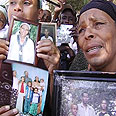
Ethiopian immigrants protest
צילום: אלי מנדלבאום
Ethiopian community fights for aliyah
Israeli Ethiopian representatives claim government decision to allow a thousand more Falashmura to come to Israel insufficient, as State is still 'turning its back on 7,000 Jews, tearing families apart'
The government's decision to approve the aliyah of a thousand more Falashmura from Ethiopia on Sunday did not do much to quell the protests on the part of the community's representatives in Israel.
"We will continue to fight until the last Jew arrives in Israel to reunite with his family," the Public Committee for Ethiopian Jewry stated. The committee added that it "praises Israel's government for its decision to continue the aliyah from Ethiopia, but regrets and protests the government's unwillingness to complete the Jewish aliyah.
"With its decision, the government is effectively turning its back on 7,000 Jews who will continue to suffer needlessly. The people have been waiting in difficult conditions for many years. Their close relatives are already in Israel and they, determined and obstinate, will continue to wait to be brought here."
Chairman of the United Ethiopian Jewish Organization, Avraham Nagusa, announced that the immigrants would not cease their battle until everyone eligible for aliyah arrives.
In an interview with Ynet Nagusa said, "We are glad for every Jew permitted to arrive, but our demands are legitimate seeing as Israel's government has promised that no Jew will be left in the Diaspora. The government is making a historical mistake, and I ask the prime minister and the minister of interior not to tear these families apart."
Absorption Minister Eli Aflalo objected to the bill that was passed by the government on Sunday, and demanded to verify the eligibility for aliyah of the remaining 8,700 people still residing in a camp in Gondar, Ethiopia.
Last week the State Comptroller's Office announced it had completed its investigation into the matter, and that it would publish a report in two weeks time. The office has researched the subject thoroughly, gathering testimonies in Israel and Ethiopia.
