


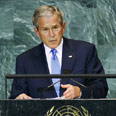
Bush: Terrorism has no place in modern world
In his eighth and final address to the United Nations, US President Bush says multinational organizations needed now 'more than ever' to combat extremists, accuses Syria and Iran of backing terrorism
US President George W. Bush accused Syria and Iran Tuesday of sponsoring terrorism and said that such violence "has no place in the modern world" in his farewell speech to the UN General Assembly.
Bush, who once expressed disdain for the United Nations, says multinational organizations are now “needed more than ever” to combat terrorists and extremists who are threatening world order.
"A few nations -- regimes like Syria and Iran -- continue to sponsor terror, yet their numbers are growing fewer and they're growing more isolated from the world," he said.
"Like slavery and piracy, terrorism has no place in the modern world. Around the world nations are changing these words into action," Bush said.
"Terrorist acts are never legitimate" and as the threat of terrorism grows "joint actions have spared citizens from many devastating blows," he said.
In his eighth and final speech to the UN, Bush said the international community must stand firm against the nuclear ambitions of North Korea and Iran. He scolded Russia for invading neighboring Georgia. And he said that despite past disagreements over the US-led war in Iraq, members of the UN must unite to help the struggling democracy succeed.
Bush also urged the United Nations and other multilateral organizations to focus less on bureaucracy and more on results.
'Vigilant against proliferation'
Bush urged UN member states to enforce sanctions against Iran and North Korea over their nuclear programs. "We must remain vigilant against proliferation," Bush said.
Foreign ministers from Britain, China, France, Germany, Russia and the United States are planning to meet on Thursday to discuss the possibility of drafting a fourth UN sanctions resolution against Iran over its nuclear program. Previous rounds of sanctions and an upgraded offer of economic incentives have failed to budge Iran, which denies it is seeking nuclear weapons and insists it only wants civilian
nuclear energy.
Iranian President Mahmoud Ahmadinejad, who was present in the chamber for Bush's speech, was certain to contradict Bush when he addresses the assembly in the afternoon session.
Sarkozy: Expand G8 to include China, India
Following Bush was French President Nicolas Sarkozy, who called for a summit of world leaders by the end of the year to address the financial crisis he said required international cooperation.
"We have retreated too long when faced with the need to give the globalized world the institutions that will
regulate it," Sarkozy told the General Assembly. "Let us build together a regulated capitalism in which whole swathes of financial activity are not left to the sole judgment of market operators," he said.
Sarkozy also called for the G8 group of leading industrialized nations to be expanded to include China, India, South Africa, Mexico and Brazil.
"Europe's message to all states is that it cannot accept the use of force to settle a dispute," he said. On
the topic of Iran's nuclear program, Sarkozy reiterated that Europeans would never tolerate a nuclear-armed Iran. "Which would endanger the peace and stability of an entire region, nor can it tolerate Iran calling for the destruction of... Israel."
He told reporters that Paris fully supported a fourth round of sanctions against Iran for refusing to suspend its nuclear enrichment program, but acknowledged that western powers would need Russia's support to pass a new UN Sanctions resolution.
Bush and other world leaders sought on Tuesday to contain the fallout from a financial crisis engulfing Wall Street and sending shock waves across the globe.
The Associated Press and Reuters contributed to this report
