


A new home
צילום: דורון גולן
Haifa: Home destroyed in Second Lebanon War rebuilt
Home was destroyed by Hizbullah rocket that also killed three people. After fighting government bureaucracy, families gain new home. Haifa Mayor Yahav: The home can be rebuilt, but the scar is forever etched in the soul of the city and the families
For more than two years, the empty lot in the middle of Caesarea Street stood as an open wound in the heart of the Wadi Nisnas neighborhood in Haifa; a monument to both a tragedy when during the Second Lebanon war, a rocket hit a house killing three people and a monument to Israeli bureaucratic red tape, which managed to drain the energy of the families whose homes were destroyed.
As far as the city of Haifa is concerned, Sunday marked the day when the war truly ended. The mayor of Haifa, Yona Yahav, and the members of the Huri and Salum families, inaugurated their new home, which was built after a lot of red tape.
On the 6th of August, 2006, at around 19:30 pm, Hiafa was attacked by a barrage of rockets launched by the Hizbullah from southern Lebanon. The rockets landed in various points throughout the city, including the lower city of Haifa, the Hadar and Wadi Nisnas neighborhoods and even the Carmel.
The rockets that landed in Wadi Nisnas claimed the lives of Leviva Mazauwi, 67, Hana Hamamm, 62, and severely injured Hamudi Salum 40, who died of his wounds a year later. The same attack also claimed the life of Roni Rubinski, aged 30, who was in the lower city of Haifa at the time of the attack.
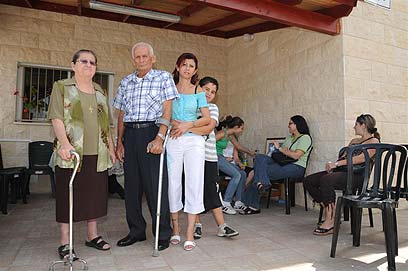
The families in front of their new home (Photo: Doron Golan)
Both The Salum and Huri family homes were destroyed. Nabila Huri, who resided in a nearby house at the time, recreated the events of that day: "The alarm sounded at around 19:30 pm. My mother and I entered the security room, my father immediately followed. When the missiles hit, I remember screaming, because the impact sounds were close together and surrounded us.
"What I remember is the house falling down on us, we were buried, my parents and I, under the rubble. There was a lot of dust and it was extremely dark; we were like that for about 40 minutes until I managed to find a hole in the rubble. I stuck my hand out and waived it about with a piece of clothing that I had found. My neighbors, along with the rescue workers, saw me and pulled us out," recalled Huri.
After the families were rescued, it was discovered that they were now homeless. Unlike other buildings that were damaged during the war in Haifa and northern Israel, the houses of the Huri and Salum families needed to be rebuilt from the ground up.
"There was a lot of government bureaucracy," said Huri. "There were problems with the budget, questions on what we were allowed to build and what we couldn't build. It took over a year, from the initial hit, before construction started, and even then our problems continued. I hope now that now our troubles really are over."
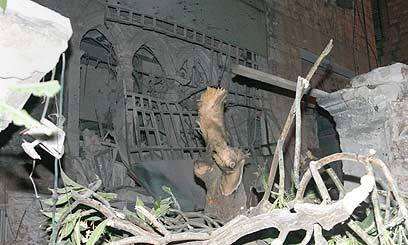
The house that was destroyed during the war (Photo: Mike Gordon)
Haifa Mayor Yahav worked with the National Insurance Institute on beginning the construction and helping the families. He reminded the public that on the night of the missile attacks he, along with the bishop of Haifa's Christian community, arrived at the location of the missile strike and the two closely followed the evacuation of those who were injured.
Yahav also expressed sadness at the fact that Hamudi Salum did not live to see this day. "Today the war is finally over in Haifa. The physical part of the fighting is done; the home can be rebuilt, but the scar is forever etched in the soul of the city and the families," he said.
Nabila Huri added that "in the last two years we have met a lot of people who wished to help us. Now I only hope that there will be peace in this wonderful country. There are many people from many nationalities who live here and we deserve some peace."
