


Knesset adopts special needs workers
In ceremony filled with smiles and tears, 15 disabled trainees absorbed for different roles at Israeli parliament. New employees will have same rights and duties as all other workers
The new workers have been filling the same roles for years as part of a project launched by the Elwyn and Shekel associations for the integration of disabled people in the Knesset, in accordance with the associations' rehabilitation plan of special care in workplaces.
The Knesset joined the project in June 2006 and took in 15 trainees with special needs, who were integrated into the parliament's various departments and carry out assignments which match their abilities, with the appropriate guidance.
On Wednesday the Knesset decided to absorb the trainees as regular workers and start employer-employee relations instead of connecting through the associations.
The trainees were diagnosed by the Industry, Trade and Labor Ministry in order to examine their employment ability. They were then absorbed by the Knesset through employment contracts and their salaries were matched to their level of ability, in addition to special bonuses paid by the Knesset.
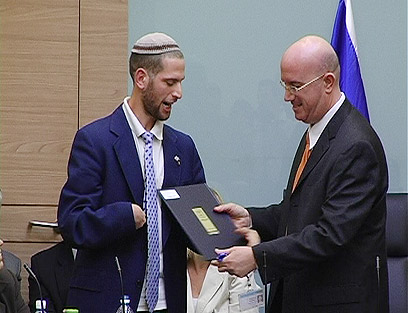
Knesset director-general gives Nadav Halperin a badge and certificate (Photo: Avi Mandelbaum)
"When Eliezer was born, one doctor told us that he won't reach the age of six mentally. Today he can be proven wrong," Tova Haitovich, the mother of one of the new workers, said with pride.
'They receive excellent treatment here'
"No one can fire you. You can sleep quietly and relax. Do you know that I love you?" Knesset Speaker Dalia Itzik, one of the move's initiators, asked the new workers during the ceremony.
Itzik, who knows each worker personally, told the new employees' excited relatives about their work.
"I'm glad this ceremony is being held today and that the awareness of the possibility of absorbing special needs workers has been raised among government offices as well as private bodies," said Shosh Turgeman of the Elwyn association.
"They receive excellent treatment here. It's really all from the heart without any pity. They are good workers and are treated well, and it's heartwarming," she added.
"I think people will look at me differently now," said Avi Zari, a new worker at the Knesset archive. "Even when we were treated as kings here and they really loved us here, they always said we were here on behalf on Elwyn. Now, instead of 500 workers, the Knesset has 515 workers."
Some of the workers, women and men, are married and have children. They fill various positions in the Knesset, including ushers, switchboard operators, messengers, secretaries and cloakroom attendants.
"They work like any other Knesset employee, with the same duties and same rights," said Knesset Director-General Avi Balashnikov.
"The Knesset workers' committee represents them and takes care of them and the Knesset management embraces them," he added excitedly. "I certainly hope, really hope, to see the rest of the government offices and public service in the State of Israel follow in the Knesset's footsteps."
