


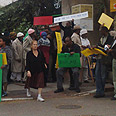
Rally outside Likud headquarters
צילום: אבי כהן
Ethiopians protest nixing of candidate from Likud roster
Dozens of community members rally outside Likud's Tel Aviv headquarters in protest of party's decision to disqualify Ethiopian candidate chosen for one of immigrant slots on its Knesset list
Several dozen Ethiopian protesters rallies outside the Likud party's Tel Aviv headquarters on Sunday, in protest of the party Election Committee's decision to disqualify the Ethiopian candidate's win of one of the slots reserved for immigrants on its Knesset roster.
The party has secured the 21st and 28th slots on it roster for representatives of the Russian and Ethiopian immigrant communities.
The petition against Alali Adamso's election, filed by two candidates who lost to him in the party primaries held earlier in December, said that since the Likud Codex states that only those who came to Israel after 1985 can bid for the slots, and Adamso came to Israel in 1983, he was ineligible to bid in the first place.
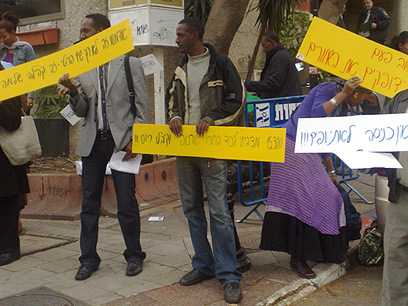
No Ethiopians allowed? (Photo: Avi Cohen)
The committee granted the petition saying that "this is a difficult case, since even though Mr. Adamso received a large number of votes, which may be lost if he is disqualified, accepting his bid would be a deviation from the party code."
The protestors gathering outside the offices called the decision discriminatory and waved signs reading "No Ethiopians allowed," and "Likud members voted for an Ethiopian and got a Russian."
"We are decent people and citizens of this State. This wrongs Adamso personally, but it wrongs the entire Ethiopian community as well. It is inconceivable that the Likud's Knesset roster won't have an Ethiopian representative," said one of the protestors.
Adamso said he intends to appeal to the Likud Court in order to overturn the committee's decision.
Avi Cohen contributed to this report
