


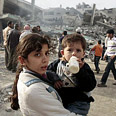
Children in Gaza
צילום: רויטרס
For the sake of the children
Israeli parents urge PM to avoid any military option that may kill Gaza children en masse
There are 22 children in our son’s kindergarten, yet these days, when everyone has the flu, barely 17 kids make it on a good day – this is exactly the number of children killed in Gaza on one day last week; we can say that a whole Gaza kindergarten had been wiped out that day.
Ever since the operation started, you cannot help but hear dozens of military and political tips regarding the way the war should be managed. Should we focus on air assaults or embark on a ground incursion, should we topple Hamas or merely exhaust it? Yet within this sea of commentary and strategy, we too want to say something.
This has nothing to do with military tactics, or with the question of using Egyptian mediators in order to secure a lull agreement. This is just one simple advice from two citizens to the prime minister they did not even vote for: When you write down the various diplomatic and military options available to you, cross out those that pose a risk of wiping out kindergartens. That’s it.
Keep all the other options, weigh them carefully, and choose whatever you see fit. Yet in respect to all the options that may end up killing a double-digit figure of children – take a red pen and cross them out. Even if on the face of it they appear to be promoting our future or our children’s future, or even the future of peace in the Middle East.
As an entity that is located in one of the world’s bloodiest regions, we believe that despite all the difficulties we’re faced with we always have the ability to choose. And we prefer to choose a future that has not been built on the corpses of young souls, even if those are our enemy’s children.
We know that this is a naïve thing to say. We know that they are deliberately firing at us from within populated areas. We also know that the children in southern Israel have been hurt, both in body and soul, with Hamas leaders not caring about this at all.
War for our identity
The thing is, we have a three-year-old child who every morning comes to our bed and demands hot chocolate. And when we lie down with him next to us and imagine how cold and empty the bed would be without him, we feel that it is impossible to justify any choice that takes away a child from his parents’ bed.Indeed, our enemies don’t necessarily think the same way – so what? Our enemies also grow long beards and take pleasure in screaming “Allahu Akbar.” And as our mothers always said, we don’t always have to learn the bad things from them.
The war we are fighting is not only for our lives and land; it’s also a war for our identity. And yes, this insistence of ours may appear to be a weakness, yet it’s a much greater weakness to allow the people we are fighting dictate our moral positions.
Just a few years ago, any surgical strike that killed innocent neighbors stirred a public debate. This past week, hundreds of civilians were killed in Air Force strikes and no hint of doubt emerged. It appears as though the consensus slowly crawled in a direction that enables us to accept, relatively easily, all those things that a few years ago we were not able to digest. The big question is why: Has the threat to our existence grown so much, or perhaps we just became more frustrated and indifferent?
Even if Mr. Olmert bothers to listen to us, he would surely rush to argue that it’s very easy to observe from the sidelines and say what we shouldn’t be doing; he would say that it is our duty to say what we should be doing. I wish we had a brilliant answer that would cure all the ills of the Middle East, but as we don’t have an answer like that, we’ll make do with a small word of wisdom. A very small one. A three-year-old kind of wisdom that crawls into your bed every morning. It’s not about where we shall be in 10 years, but rather, about where we are now.
Etgar Keret is an author and screenplay writer. Shira Geffen is a screenplay writer, playwright, and children’s author
