


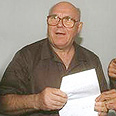
John Demjanjuk
צילום: לע"מ
US postpones Demjanjuk deportation
Federal judge said to grant former Nazi guard indefinite stay of deportation to Germany pending further review of case by US courts
John Demjanjuk, believed to be "Ivan the Terrible" of the Sobibor death camp in Poland, was granted a temporary stay of deportation by an immigration judge.
Demjanjuk's attorney John Broadley said the stay is indefinite until the judge re-opens the case.
Demjanjuk was expected to be deported on Sunday, then be in Germany on Monday but argued that he was too frail to be deported.
The 89-year-old was to arrive Monday in Munich, where he was expected to and indictment which includes 29,000 counts of accessory to murder.
A federal judge stopped the deportation proceedings late Friday in what was described the latest twist in a legal journey over his wartime past.
US Immigration Judge Wayne Iskra's ruled that the 89-year-old retired autoworker can remain in his Seven Hills home until the judge decides whether sending him to Germany would constitute torture, as his family claims. A decision could take anywhere from days to a few months.
"There's a reason John Demjanjuk is still in Seven Hills today: He's not the guy," Demjanjuk's son, John Jr., said Friday.
German prosecutors are prepared to show that Demjanjuk worked as a Nazi guard who walked Jews from the rail cars to the gas chambers, according to court records and published reports. The prosecutors have Nazi documents first used in Cleveland nearly 10 years ago to help prove their point.
In 2002, a US district court ruled that Demjanjuk lied about his wartime past when he entered the United States in 1952 and stripped him of his citizenship, saying he "contributed to the process by which thousands of Jews were murdered by asphyxiation with carbon monoxide" at the Sobibor camp.
Demjanjuk's family claims that he is too frail to go to Germany, alleging that he has a blood disease, chronic kidney disease and severe pain in his hips, back and legs.
In court filings, they said the plane ride to Germany, his arrest and jailing there and a trial would amount to torture; but US Justice Department lawyers denied that, saying that there is no evidence to prove that a German trial would amount to torture, only Demjanjuk's own subjective fears; and adding that Demjanjuk's motions were a legal "Hail Mary" that sought to put aside several US judges' rulings that said he should be deported.
Demjanjuk's case began in 1977, when he was first accused of being "Ivan the Terrible," a sadistic guard at the Treblinka death camp. He was extradited to Israel, convicted and sentenced to death before the Israeli Supreme Court overturned the conviction.
