


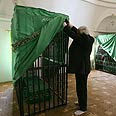
Muslim shrines bear witness to Iraq's Jews
Though converted into Muslim places of worship, shrines of Ezekiel, Ezra and Daniel in Iraq maintain their Jewish features and are being preserved by locals
Nearly everyone who could read the Hebrew verses carved into the walls of Ezekiel's tomb left Iraq almost 60 years ago, but their memory is preserved in what is today a revered Muslim shrine.
Between 1948 and 1951 nearly all of Iraq's 2,500-year-old Jewish community fled amid a region-wide outbreak of nationalist violence, but today Iraq's Muslims and Christians still visit its most important holy sites.
In the little town of Kifl, south of Baghdad, the shrine of Ezekiel - the prophet who followed the Jews into Babylonian exile in the 6th century BC - has long been a part of Iraq's millennia-old religious mosaic.
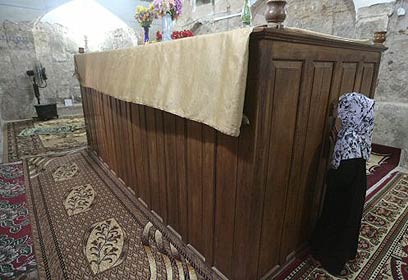
Muslim woman praying near Ezekiel's tomb (Photo: AFP)
A 14th-century brick minaret tilts outside the entrance to the shrine, but inside the mosque is shaped like a synagogue, with old wooden cabinets that used to hold Torah scrolls and balustrades that once separated men and women.
Inside the shrine, block-like Hebrew script runs along the old stone walls beneath a Turkish-style dome with medieval Islamic floral designs.
The government has launched a project to renovate the interior of the shrine, and the state ministry for tourism and antiquities says it hopes to eventually repair and renovate other Jewish sites across the country.
Muslims revere nearly all the central religious figures from Judaism and Christianity, including Ezekiel. He is referred to as Dhu al-Kifl in two Koranic verses and is said to have raised the dead.
In the southern town of Al-Azair, Bashir Zaalan, a Shiite Muslim, cares for the shrine of Ezra, the towering scholar of Jewish law said to have led several hundred Israelites back to Jerusalem in the 5th century BC.
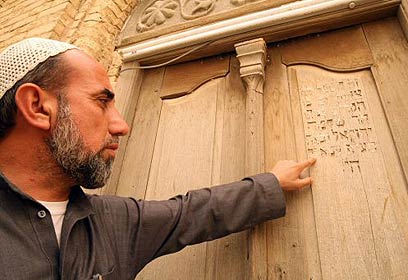
Bashir Zaalan shows Hebrew text at shrine of Ezra (Photo: AFP)
In the northern town of Kirkuk, Jews would hike up the city's 4,600-year-old citadel to seek blessings at the - likely apocryphal - tomb of the prophet Daniel, now a Muslim shrine decked with green banners.
Baghdad as a 'Jewish City'
Prior to the exodus in 1948, Jews made up around a third of Baghdad's population and played a major role in the political, economic, and cultural life of the country. Today the population has dwindled to single digits.
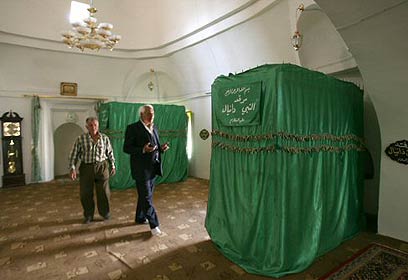
Worshippers at shrine of Daniel (Photo: AFP)
Their troubles began in the early 1930s, with the rise and gradual radicalization of Arab nationalism and the simultaneous arrival of Zionism, with emissaries mobilizing Jewish youth and urging emigration to Palestine.
The process culminated with the birth of Israel in 1948, the first Arab-Israeli war and Operation Ezra and Nehemiah, which flew more than 120,000 Jews – 96% of Iraq's Jewish population - to Israel in 1951.
'Iraq should be a tourist destination'
For the few Jews who remained in Iraq, conditions grew worse and worse over the following decades as the Arab-Israeli conflict festered and Iraq weathered political upheaval, wars and international sanctions.
In the violence that erupted after the US-led invasion of 2003, Iraq's few remaining Jews went into hiding as sectarian militias marauded across the country, slaughtering Muslim rivals as well as Christians and other minorities.
But in the face of the reduced bloodshed of the past two years, the government has started to take a new look at the country's many cultural treasures and their potential as a lure for tourists.
The faithful from three religions may soon make their way again to the Kifl shrine, near which Ezekiel is said to have walked through a valley of dry bones and seen God lift them up and clothe them with flesh.
"Iraq should be a tourist destination. If any delegation comes with permission from the government they are most welcome," Abdelhadi said with a smile. "As long as they are only coming to visit."
