


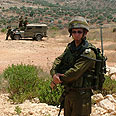
Soldiers stationed in Bilin: Gaza is easier
Ynet reporter accompanies 75th Armored Brigade responsible for region where anti-fence rallies are held every Friday. Troops speak of difficulties in face of protestors, say 'demonstration can be dispersed very fast, but we limit our use of fire'
This Friday we accompanied the troops, who deal with the disturbances near the fence on a weekly basis. One of them explained the difference: "In Gaza you spot a terrorist, fire a shell, and it's over. Here you face citizens who hurl a stone or a Molotov cocktail, but your ability to respond is limited.
"It may appear that we are the ones using force here, but in reality that's not the case, as we are subject to very difficult restrictions."
Every Friday, hundreds of Palestinians and left-wing activists from Israel and abroad arrive near the separation fence and lead to a violent clash with the security forces. In the past two months, this region has been the responsibility of Lieutenant-Colonel Amir, a regiment commander, who only several months ago led his soldiers in Operation Cast Lead in the Gaza Strip.
Now, after the Binyamin Territorial Brigade gained control of this area, he deals with dispersing the violent riots every week.
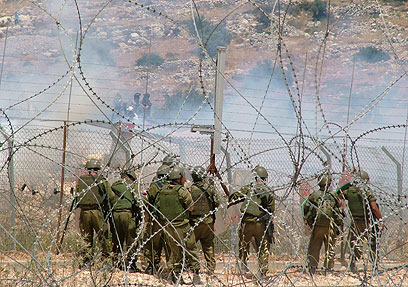
"The name of the game is very clear here," one of the soldiers says. "If the forces fail to end the demonstration within half an hour, they will cause damage to fence worth about a million shekels."
Since the beginning of the year, the accumulated damage caused to the fence in this region has been estimated at NIS 300,000 (about $76,640).
'Don't want to inflame the situation'
Preparing the force to handle demonstrations is a military operation for all intents and purposes. The regiment commander, along with Border Guard forces, are well prepared for the rallies.
"Our goal is not to inflame the situation, but rather let the event end as calmly as possible," a military source explains to Ynet. "Unfortunately, the demonstrations quickly turn violent and include the use of stones, Molotov cocktails, hurling stones with a machine-gun, which only several weeks ago seriously injured the hand of one of the tank commanders. Therefore we must use the means we possess in order to calm things down."
The Bilin rally began on Friday at around 1:30 pm, as dozens of Palestinians began making their way towards the fence along with several Israelis following the Friday prayer at local mosques.
The Hebrew and Arabic announcement by the IDF force warning the crowd not to approach the fence did not help, and within seconds several tires were set on fire and stones began flying towards the soldiers on the other side of the fence.
The Lavi company commander sent a small force of soldiers, all covered with shields, towards the fence in order to throw some tear gas grenades at the protestors who refused to leave the area. Regiment Commander Amir supervised the activity from aside.
"This is a complicated and not a simple incident," a regiment source explains. "This demonstration could have been dispersed very quickly, had significant measures been used. But we are limiting our use of fire and acting very carefully. There are different levels of escalation and no rubber bullets or smoke bombs are fired pointlessly, but only in order to disperse the demonstrations."
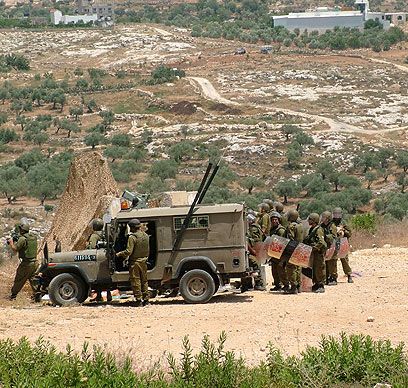
Soldiers prepare. Firing only following order
In light of the incident in which a Palestinian protestor was killed in the same area about a month ago, the IDF has changed its instructions in terms of the firing of smoke bombs so as not to physically harm the demonstrators, although an investigation into the incident revealed that the bomb hit an electric cable and was shifted towards the Palestinian man.
The regiment has only been stationed in the area for two months, but its soldiers say that the demonstrators use every means against the forces, including hurling stones and hiding behind disabled people in wheelchairs in order to prevent the security forces from using crowd dispersal measures against them.
Those who give the soldiers permission to use gas or rubber bullets are only the commanders standing next to them. The commanders comb the area and give them a green light only after considering the matter.
Half an hour after the start of the demonstration, one of the soldiers was hit by a stone in his knee and received medical treatment on the scene. The other troops, whose eyes sting from the tear gas which reaches them as a result of the wind, continue to calm things down and distance the protestors from the fence.
Gaza favored
About an hour later, the demonstration ends and the soldiers prepare for their other missions. One thing is clear, however: Asked what they prefer to do in uniform, they all say that they favor the real war inside tanks against the terrorists in Gaza over the battle against citizens in Bilin and Naalin.
Regiment sources say that the clashes are often reminiscent of battles in ancient times, without firearms, and that the clash takes place with the sides very close to each other. This Friday, for instance, the demonstrators brought bottles containing red paint and hurled them at the soldiers.
IDF officials stress that the forces are using minimal force in this confrontation, making the clash much more complicated for them but aimed at avoiding hurting the Palestinians as much as possible.
In Naalin, the "playground" in which the demonstration is held is larger, and thus the rally is considered more violent and unruly, and every incident which takes place in one demonstration is expressed in the following ones. For example, after Palestinian citizen Ibrahim Abu Rahma was killed in one of the demonstrations, the following one was much bigger.
According to the regiment sources, even world events affect the demonstrations. When a shoe was thrown at former US President George W. Bush during a press conference in Iraq, the Palestinian protestors launched a new method of throwing shoes at the forces.
In general, the regiment sources say, Naalin's residents are creative and constantly adopt new ways to expand the demonstration. For example, they carry steel signs with different captions in Arabic, which are also used as a human shield against the rubber bullets fired by the IDF soldiers.
