


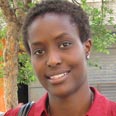
Stephanie Nyombayire
צילום: Stacey Maltin
Combating contemporary genocide
New documentary film ‘Heroes of the Holocaust’ shows fighting genocide should be a priority and never again something people decide to care about after the fact
The tragedy of the Holocaust and the massacre of the Jewish people taught the lesson that it can take too much time for the world to stand up and recognize genocide. It wasn’t until millions of Jews had already died that the international community decided to do something about it. It would make sense that having learned this lesson once the world would never again let history repeat itself. However, contemporary genocide has been alive and rearing its ugly head. We saw it in Rwanda 10 years ago and genocide in Darfur is still happening this minute.
Even in an age where information is readily accessible, people are still able to turn their backs on modern day mass murder. Society is so globalized that people can turn on their televisions or hop online and know what is happening around the world minutes after it happens. So why does the global community let this kind of history repeat itself?
Rwandan human rights activist Stephanie Nyombayire, who lost 100 family members in the Rwandan genocide, answers "People read books or watch movies and feel bad about what is happening but don’t think they can make a difference. What we need to do is bridge the gap between the massive amounts of available information and the idea that your neighbor can be someone who lives around the world."
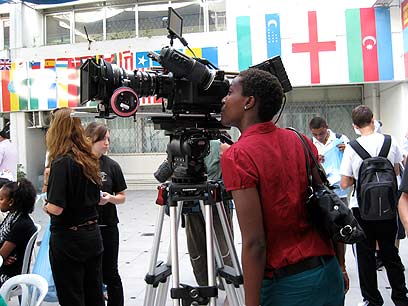
Stephanie Nyombayire filming in Tel Aviv (Photos: Stacey Maltin)
Nyombayire is currently working on a documentary collaboration with award winning filmmaker Michael King, and biographer Sir Martin Gilbert titled "Heroes of the Holocaust." The crew is traveling to 12 countries in 38 days in an effort to draw parallels between what people did (and didn’t) do during the Holocaust and how the modern world has responded to recent atrocities.
The film focuses on non-Jewish diplomats who helped people escape the Holocaust by giving them visas. Many of the diplomatic officials risked everything in an effort to save Jews and often lost their jobs, ended up in poverty, or even died so they could help people. By exploring the efforts of past diplomats, the collaborators are hoping to encourage diplomats who are currently in office to help by taking governmental action.
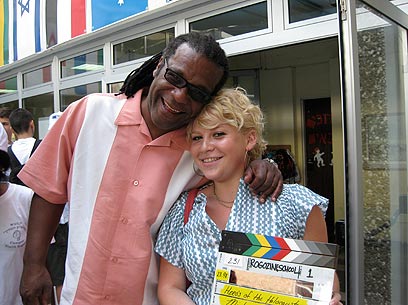
Director Michael King with one of the production crew members
Filming in Israel
After visiting France, Italy, Hungary, Denmark, Poland, Lithuania, Rwanda, and Great Britain, the filmmakers came to Israel to explore genocide past and present. One day was spent at Princess Alice of Greece’s grave in the garden of Gethsemane paying tribute to a woman who hid Jews in the royal palace during the German occupation. One day was spent filming at Yad Vashem, and one day was spent visiting Darfur refugees at schools and Refugee camps in Israel, uniting old and new wounds.
The Rogozine school in Tel Aviv’s Florentine section has a campaign headed by the principal to take in child refugees from Darfur. There are currently 55 refugees learning at the school alongside Jews, Christian, Muslims and the children of foreign workers from all over the world. Principal Karen Tal feels it is her mission to motivate the kids with an emphasis on creativity and the arts to earn their trust and break down emotional roadblocks.
Director Michael King concluded: "It’s about their generation now. They are the future who we are making these films and teaching these lessons for."
