


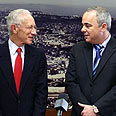
Fischer (L) with Steinitz
צילום: גיל יוחנן
Talks on new Bank of Israel Law hit impasse
Governor Stanley Fischer sends Finance Minister Yuval Steinitz memo going back on all agreements made over past two years. Treasury's insistence on supervising Bank's employees' wages believed to be bone of contention
The lengthy negotiations between the Bank of Israel and the Treasury regarding the amendments to the Bank of Israel Law entered to a standstill Wednesday, as Governor Stanley Fischer informed Finance Minister Yuval Steinitz that the Bank reneges on all of the agreement made over the past two years.
The Bank and the Treasury, under the various governments, have been trying to formulate amendments to the 50-year-old law for the past 10 years, with several drafts going back and forth with no real progress.
Major breakthroughs were noted over the past 24 months, with the sides agreeing on issues ranging from the make up of governmental committees to foreign currency and interest policies – all of which Fischer has now effectively rendered null and void.
A spokesman for the Treasury said the ministry was "shocked and furious over the Bank's move," adding that 95% of the issued had already been agreed upon, and that Fischer's decision means "thousands of works hours have gone to waste."
The bone of contention is believed to be Fischer's demands to exclude Bank of Israel employees from Article 29 of the Budget Fundamentals' Law, which is a derivative of Basic Law: The State Economy. The section states that Bank employees' wages must be supervised by the Treasury.
Finance Minister Yuval Steinitz said that Fischer's memorandum cannot be the basis for any kind of talks, adding that "if the Bank is going back on the deal, the Treasury has some new ideas for a variety of issues as well."
Steinitz said that he sees the ministry's continued supervision on Bank employees' wages as a "prerequisite to transparency and proper administration. It is a fundamental principle and we will not deviate from it because it does not infringe on the Bank's independence."
The Bank of Israel was unavailable for comment.
