


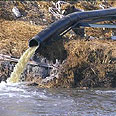
Report: Settlements polluting West Bank streams
Third of West Bank settlements are not connected to sewage system, and untreated wastewater flood natural water resources in area, says B'Tselem report. Ministry of Environmental Protection: Palestinians refuse to cooperate on issue
Israel and the Palestinian Authority's failure to treat wastewater in the West Bank has harmed the health and future water supply of all residents of Israel and the West Bank, human rights group B'Tselem said in a report published Sunday.
In the report, titled, "Foul Play: Neglect of Wastewater Treatment in the West Bank," B'Tselem argued the wastewater of two million of the 2.8 million people living in Jerusalem and the West Bank is not treated.
The organization claimed that the prolonged neglect has created various hazards and environmental nuisances throughout the West Bank and is liable to pollute the Mountain Aquifer, the main water source of Israelis and Palestinians.
Since the beginning of the settlement enterprise, said the report, Israel has not constructed advanced regional wastewater treatment plants in the West Bank settlements as it has done inside Israel. Only 81 of the 121 settlements are connected to wastewater treatment facilities, and even these are outdated and are not able to treat the necessary amount of sewage.
Of the 17.5 million cubic meters of wastewater created annually by the settlements, 5.5 mcm flow as raw sewage into West Bank streams and riverbeds, stated B'Tselem, adding that the Israeli Ministry of Environmental Protection "has failed to take serious enforcement actions against settlements."
Villagers suffer most
Over the years, said B'Tselem, the Jerusalem Municipality has proposed a few solutions for treating this wastewater, but none have been implemented. These solutions require the cooperation of the Palestinian Authority, which has refused, claiming that its cooperation would legitimate Israel’s annexation of East Jerusalem.
"Palestinian towns and villages in the West Bank produce 56 mcm of wastewater annually, 62% of all wastewater in the West Bank. Some 90-95% of Palestinian wastewater is not treated at all, and only one Palestinian wastewater treatment plant is currently functioning."
The group attributed the lack of infrastructure to a number of factors: "First, the Israeli authorities have delayed approving plans for building treatment plants, in some cases for more than a decade. In addition, Israel attempted to force the Palestinian Authority to connect settlements to the planned treatment plants, and the PA rejects this demand for political reasons."
The first victims of the neglect of wastewater treatment are Palestinians, primarily residents of small towns and villages, who depend on water from natural sources – springs and wells – whose pollution causes disease and harms crops. Because settlements are generally at higher altitudes, their untreated wastewater flows down to nearby Palestinian communities, concluded the report.
Israel: Palestinians refusing to cooperate
In the report’s conclusions, B'Tselem demanded that Israel treat all settlement wastewater in accordance with the treatment standards applied in Israel, and that the authorities enforce the law on polluting settlements. B'Tselem further demanded that the government of Israel and the Palestinian Authority cooperate in advancing Palestinian wastewater treatment projects, even if this necessitates facilities that will treat both Palestinian and settlement wastewater.
The Environmental Protection Ministry said in response: "The data for the B'Tselem report was provided by the Environmental Protection Ministry, and the claim that the ministry has refrained from enforcing the law is groundless and untrue. The only period when enforcement measures had not been taken was during the armed intifada in the years 2000-2003, when it was impossible to move in the West Bank."
The ministry noted that the Palestinian Authority has repeatedly declined proposals to open a facility for treating Jerusalem's wastewater. "Israel is willing to assist and cooperate with the Palestinian side in advancing solutions for the shared ecological problems, but has encountered nothing but refusal from the Palestinians," said the statement.
