


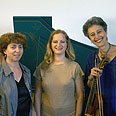
The Phoenix Ensemble
A taste of Scotland
Phoenix Ensemble will conclude their current season with a taste of Scotland featuring some of the songs and music from the colorful Scottish history of love, life and battle
‘A thousand good fortuns fall to her share
Although she hath rejected me
And fill’d my sad heart full of despaire
Yet ever shall I constant be.’
No, this is not a sample of my poor spelling but a few lines from “Joy to the Person of my Love”, an anonymous 16th century Scottish song, one of the songs to be heard in the PHOENIX concert “In the Green Fields of Scotland” at the Jerusalem Center for Near Eastern Studies, Brigham Young Mormon University, July 12th, 20:00.

The program will also include some instrumental music. Herzog will play some bagpipe melodies on the viol. Italian composer and violinist Francesco Maria Veracini (1690-1768) spent time in London, where he heard the Scottish tunes so in vogue there at the time. He incorporated the popular “Tweedside” melody in one of his “sonate accademiche”, sonatas probably performed for private concerts or academies.
Those performing will be Brazilian-born viola da gamba player Myrna Herzog, a soloist, researcher, teacher and the founder and musical director of the PHOENIX Ensemble. Herzog’s creative programming characterizes all PHOENIX concerts. Harpsichordist Marina Minkin immigrated to Israel from the Ukraine in 1981. Minkin performs frequently and has researched historical performance. She also performs and has recorded new works for harpsichord. Israeli soprano Tamar Kleinberger has a strong background in theatre and the English language. These, together with her robust, direct style are well suited to the freshness and underlying humour of Scottish songs.
