


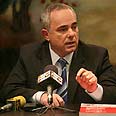
Steinitz: Financial crisis not over yet
Finance minister, top industrialists say that while CBS data indicating market growth in Q2 2009 positive, it is still too early to say recession is over
Prime Minister Benjamin Netanyahu seemed pleased with the Central Bureau of Statistics' data indicating the Israeli market noted signs of growth over the second quarter of 2009.
"The figures noted over the past few quarters indicate that the Israeli market is doing better than other leading world markets," he said. "The rise in private consumption, exports and tax revenues is very encouraging."
Netanyahu added that he and Finance Minister Yuval Steinitz would continue to advocate economic policies conducive to the market's growth and stability.
Steinitz, however, seemed more wary: "This is a very encouraging report and it's the latest in a series of positive indicators seen over the past few weeks, indicating that the economy is stabilizing," he said in response to the CBS data.
"We are positive that the financial plan and the biennial budget devised by the government would continue to contribute to the market's rapid growth.
"Nevertheless," he continued, "It's still too early to announce that the recession is over and that the financial crisis is behind us… The government will continue to act in order to curb the effects the recession has on the Israeli markets."
'Too early to celebrate'
Encouraging data aside, some of Israel's top industrialists said Sunday that it was too early for the market to celebrate the end of the financial crisis.
Elisha Yanai, CEO of Motorola Israel and head of the Association of Electronics & Software Industries within the Manufacturers Association of Israel, said that "while I wish I could join the optimistic projections, a 1% growth for the country the size of Israel, is very much a recession.
"We need a growth of at least 2% (in GDP) to keep the standard of living from slipping. Anything less is a recession… I hope we will see the market recover – the signs are there. World markets are recovering and it will affect Israel because when the world buys more – we sell more."
Avi Paz, president of Israel Diamond Exchange, also expressed some reservations: "I certainly hope it's true, that we are on the right track, but I think it's a little early to celebrate. This data reflects the performance of only one quarter.
"We, in the diamond business, still feel the recession – we experience the global economy, rather than the Israeli one. We're facing the problem of erosion in dollar rates, which affects our exports and until that is solved we will still experience a crunch."
Paz also warns of the coming inflation: "When the recession really ends, the Israeli consumer will still have to deal with a rise in inflation rates, so becoming euphoric at this point is less than healthy."
Avner Stepak, CEO of Meitav Investment & Brokerage House, however, is optimistic: "Israel demonstrated incredible resilience during the financial crisis," he said. "The recession hit us several months after hitting most Western countries and ended sooner. The worst is behind us.
"Nevertheless," he qualified, "We cannot become euphoric. First of all – 1% is not a significant number and I think we are still a long way away from the impressive growth rates we've become accustomed to. Second – you have to remember that the growth here, and in other countries, derives from a deliberate 20% increase in public expenditures."
Shaul Lotan of Levinstein Contracting & Engineering told Ynet that the real estate sector was apparently least affected by the recession.
"We didn't really feel the recession in the real estate business. Yes, there was a time when some projects were put on hold, but that's over and now were experiencing a massive demand," he said.
"I think that the local marker didn't experience a real recession as much as was affected by the alarming reports from abroad."
Tani Goldstein contributed to this report
