


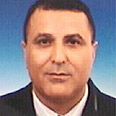
Bedouin consul supports Lieberman's army requirement
Harsh criticism of foreign minister's initiative to deny anyone who hasn't completed military service from enrolling in cadets' course, but Israel's Consul General to Alexandria Hassan Ka'bia, a Bedouin and lieutenant colonel in reserves, enthusiastically backs proposal
"I identify with what the minister said and support what he is suggesting," said Hassan Ka'bia, Israel's Consul General to Alexandria, who sought to voice his support for his boss publicly.
Ka'bia, a Bedouin who served many years in the IDF and was released with the rank of lieutenant colonel, rejects claims that Lieberman is trying to block minorities' access to the Foreign Ministry.
According to him, "For many years already, the Arab sector has ganged up against national service. There were demonstrations against national service. I say, these are people who are supposed to be partners with the State. They need to do national service at the very least: to work in the village, in hospitals, somewhere. I don't know who there will be partnership and how they want to be accepted into the civil service if they don't contribute to the society."
Ka'bia also said that he does not expect those who do not want to serve in the military to enlist. However, in his opinion, every Israeli citizen has an obligation to contribute to the community.
"National service is for the most part service to the community," said the consul general. "There are a thousand options for taking action. I am not coming to recruit them into the military. If they don't want, they don't have to. But they must contribute in order to be accepted into Israeli society," Ka'bia explained.
"If you don't identify with the State, this is a problem," he said. "I am not coming to sign them on a loyalty document, but identification is (expressed) through contribution. In order to represent the State, you must identify with it, to be familiar with the society. The cadets' course that trains diplomats is not enough. You must prove that you have done something for Israeli society. I hold Lieberman in great esteem for what he said."
Ka'bia rejected claims that Lieberman's statements are racist. According to him, "The minister's statements aren't against Arabs. He isn't speaking out against us. He is saying – this is the most prestigious course that trains diplomats to serve in various countries. As a consul, I need to explain the government's policies, the policies of what is going on in Israel. Therefore, it is not enough to come to the diplomatic corps and do a course. One needs to be well-versed – and national service helps people become well-versed in what is going on."
"I don't know who is interpreting Lieberman's statements as racist. It apparently is the media. There is a bunch of diplomats from the Druze sector, as well as Arabs and Bedouins," Ka'bia said.
