


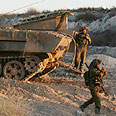
IDF soldiers (archive)
צילום: AFP
IDF to provide recycled water for soldiers in enemy territory
New initiative suggests soldiers receive drinkable, contaminant-free treated waste water while in enemy territory. Goal set to provide ever soldier in enemy territory 11 liters (2.9 gallons) of water a day
The IDF is preparing to increase the operational output of water supply to soldiers in enemy territory, after a series of discussions on the issue were held. The general staff special water unit, manned only by reservists, is responsible for the task.
"We would like to reach a situation in which we can supply drinkable water to 50,000 fighters a day," said unit commander, Lt. Col. (res.) Rami Klein.
Even though the unit has yet to participate in operational activity since its founding 22 years ago, the IDF believes that the unit's operational capabilities must be preserved, and even beefed up.
The idea is simple. With the help of senior reservists, who are some of the top-most chemistry and food engineering experts in the country, and US-developed equipment, water will be put into a portable treatment apparatus and will come out the other end drinkable and contaminant-free for the use of soldiers in the field.
"The quality of our equipment," said Lt. Col. Klein, "allows us to treat all types of water, to identify every characteristic, including chemical traces. We are prepared for any possibility, also in training, including intentional targeting of the water source aimed at harming the soldiers."
'Unit's human capital is central'
Despite reports of problems supplying water to soldiers during the Second Lebanon War, the IDF chose not to deploy the general staff's water unit. The unit is intended for action in broader-scale combat, both in terms of territory covered, and in terms of the number of troops deployed in areas that present logistical difficulties.Normally, in addition to training, the unit's experts collect information about water sources in various territories in order to prepare for the possibility of action there.
"We conduct engineering surveys and follow up on information about various water sources," Lt. Col. Klein. "Before the water is treated, the quality of the water is checked, with the objective being to reach a water source with the highest quality of water possible such that the treatment process is also the shortest."
The IDF's water official ruled that every soldier must drink 11 liters (2.9 gallons) of water during a day of fighting. Lt. Col. Klein explained that the equipment the unit currently has in its possession is capable of producing 250,000 to 300,000 liters (about 66,040 to 79,250 gallons) of chemically-treated, drinkable water a day.
"At the beginning of the 2000s, we could only produce a portion of that quantity. Now, with the decision to continue equipping (ourselves), we aim to double the output because of the understanding that there is a vital need to prepare water in advance when waging a wide-scale war," said the officer. "The human capital in the unit is a central element. These are excellent people, who know their job well and will carry it out in the best way possible when the need arises."
The unit is also addressing the manner in which the treatment equipment will be transported into the battle zone. "This is portable equipment that is towed by an appropriate vehicle, or even transported by air, that will surrounded by the appropriate security ring. However, it is clear to everyone that there will also be unexpected incidents in war, and we will need to perform in a complex zone and to give our best."
