


Netanyahu: Non-recognition of Israel obstacle to peace
In CNN interview on heels of trilateral summit in NY, PM backs Obama's call to resume peace talks without delay, but says matter of settlements should be deferred towards end of negotiations. On Iranian regime: It's weaker than people think. It doesn't enjoy the support of its own people
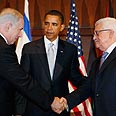
The Palestinians' refusal to recognize Israel's right to exist as a Jewish state remains the biggest obstacle to peace, Prime Minister Benjamin Netanyahu said on the heels of Tuesday's meeting in New York with US President Barack Obama and Palestinian President Mahmoud Abbas.
Speaking to CNN's "The Situation Room with Wolf Blitzer," Netanyahu backed Obama's call to resume peace negotiations as soon as possible, adding that the issue of Israel's West Bank settlements should be discussed only towards the conclusion of the negotiations with the Palestinian Authority.
The PM continued to say that Israel must make certain that any territory it cedes as part of a future peace agreement would not be used by terrorists to launch rockets.
Asked if he would be willing to withdraw to the 1967 borders, Netanyahu reiterated his demand that a future Palestinian state be demilitarized.
As for Iran, the prime minister told CNN, "I'd like to believe that the international community understands that Iran has to be pressed strongly, there are ways of pressing this regime right now because it's weak.
"It's weaker than people think. It doesn't enjoy the support of its own people," he said, adding that the prospect of Iran acquiring nuclear weapons "threatens world peace in a way that very few events could possibly threaten it."
Widely considered to be the Middle East's sole if undeclared nuclear power, Israel, like the West, suspects Iran of trying to develop atomic weapons under the guise of its nuclear program, a charge Tehran denies.
Israel considers the Islamic republic its top enemy after repeated statements by President Mahmoud Ahmadinejad that it is doomed to be "wiped off the map" and that the Holocaust was a "myth."
Netanyahu insisted that time was running out for the international community to act, saying the window was "getting shorter because Iran is moving ahead.
"But this is a regime that is susceptible to pressure," he said.
"It's been exposed for what it is. It tyrannizes its own people. Iranians detest these people as seen in the election fraud. The economy is susceptible and the time for pressure is now," he said.
A meeting between Iran and the six powers dealing with Tehran's suspect nuclear program is planned for next month in Geneva.
This will be the first such high-level meeting between Iran and the six – Britain, China, France, Germany, Russia and the United States – since US President Barack Obama moved into the White House early this year.
