


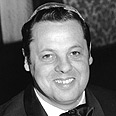
Duets that transcend time
(Video) After narrowly escaping Nazi transfer to camps, little Shlomo Reiss reunited with family in Israel, learns cantillation, returns to Germany to become country's beloved chief cantor. In memorial disc made by his son, recordings of Reiss combined with current singers in order to create moving duets that at distance of 50 years
Oded Reiss, the cantor's son, has worked in recent years on a musical memorial for his father. Recently, his album hit stores. The album, "First and Last," includes cantorial segments that were digitally remastered. A DVD is included along with the album that includes part of Reiss' performances on German television, some "behind the scenes" work. Also on the DVD is a duet brewed up by combining old clips of Reiss and Israeli singer, Momi Levy's singing.

Reiss sings 'Eli, Eli' on German TV
Reiss was born in Poland in 1928. A short time later, his family moved to Vienna. At the young age of six, his special vocal talents were already apparent, and he was chosen as a soloist in the synagogue choir. When attacks against Jews started in 1938, the family fled to Czechoslovakia. However, because of stiff immigration laws that did not allow anyone under the age of 18 from leaving the country, the family was forced to split up. Reiss' parents and older sister went to Israel, and Shlomo and his other sister stayed behind in an orphanage. From here, they were transferred to foster families.
From Israel, the family went to great measures to try and bring their children to Israel. The youth aliyah movements managed to secretly bring Shlomo's sister to Israel.
Just a short time later, Reiss was put on a transport of Jews from Czechoslovakia. To his great fortune, one of the passengers recognized him from the Jewish community and told the young Reiss that he father had "left him chocolate on the shelf near the window." When Reiss climbed up near the window for the supposed chocolate, the passenger shoved him out the window of the train, which had just left the station. Bruised and crying, Reiss started walking back towards the station, without knowing that his life had just been saved.
Reiss was taken in and cared for by a pediatrician. In the meantime, his mother in Israel managed to obtain another entry certificate to Israel, and the child was moved from Czechoslovakia to Italy and from there to Israel where he was reunited with his family.
Back to Europe
The young Reiss began studying the wonders of cantillation from leading cantors in Israel. He participated in competitions and concerts in which he won over audiences. When he finished his studies in 1959, he decided to try his luck in the US.
Within a short time, Reiss successfully strengthened Munich's Jewish community, in no part because of the youth choirs he ran.
Reiss' fame quickly ascended, not only in the Jewish community. Ten years after the Holocaust, Radio Bavaria invited him to make some recordings that would later be broadcast every Friday on the radio's frequency. In 1964, Reiss left for Canada, but the extreme cold quickly pushed him back to Germany, where the Dusseldorf community rushed to offer him a contract. Once there, he discovered that the community was barely able to scrape together a minyan (a quorum of 10 men needed for many Jewish prayers). Nor did the community have a synagogue.
The community members hoped that Reiss would attract more members and that a synagogue could be opened as a result. This is indeed what happened. He left the community three years later for Frankfurt, where he also successfully filled synagogue pews with enthusiastic admirers. Reiss started performing on radio and television, and quickly became a sought-after celebrity on talk shows.
In 1995, Reiss retired. His replacement in the community is considered to be one of the greatest cantors today – Yitzchak Meir Helfgot.
Duets through time
In the years after retiring, Reiss living between Tel Aviv and Frankfurt. Sadly, he was killed in a tragic car accident while visiting Israel.
After his death, his son, Oded, decided to collect recordings of his father to make a disc in his memory. However, once he went to work, Oded was confronted with a significant hurdle. His father, out of a deep ideological belief that cantillation's place is in the synagogue and not on tape, rarely made recordings. What Oded did have, however, were clips from his radio and television performances as well as makeshift recordings he made at home.
Using digital technology, Oded cleaned the recordings from background noises, and created duets – and one trio – between his father and cantors of our time. He also added choirs and instrumentation to the recordings in order to enrich the sound. Among those with guest appearances on the disc are Dudi Fisher, Cantor Yaakov Motzen, Cantor Israel Rand, and others.
The song "Kumi Ori," is composed from a segment of "Lecha Dodi" that Shlomo Reiss sang at the beginning of his career and words written by Hamutal Ben-Zeev and sung by Momi Levy in a moving duet 50 years apart.
