


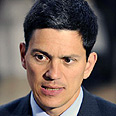
Miliband wants to renew dialogue with Hezbollah
In wake of new Lebanese government British foreign secretary calls to consider possibility of resuming contacts with Islamist group. Israeli diplomatic sources dismiss distinction between military, political wings within Hezbollah
British Foreign Secretary David Miliband is interested in approaching elements in Hezbollah in order to persuade them to abandon the armed campaign against Israel, the Daily Telegraph reported Thursday. It is unclear what the nature of the proposed dialogue would be and the ranks it would involve.
The British daily quoted statements made by Miliband during an interview with the Daily Star in Lebanon according to which he believed "carefully considered contact with Hezbollah's politicians, including its MPs, will best advance our objective of the group rejecting violence to play a constructive role in Lebanese politics."
During the interview Miliband stressed that Britain's overtures would only be extended to Hezbollah members who "value the political process, not those that seek to undermine it" and insisted that all talks would be considered on a "case by case" basis.
The British foreign secretary's statements follow his announcement in March according to which he would allow low-ranking diplomatic ties with Hezbollah in an attempt to persuade the organization to renounce violence. The British Foreign Office stressed at the time that contacts would only be conducted with Hezbollah's political wing, while its military wing was still considered as a banned terrorist group.
Last June British Ambassador to Lebanon Frances Guy met with Hezbollah faction head in the Lebanese parliament Mohammad Raad. It marked the first time a meeting was held between a British ambassador and a senior member of the Lebanese Shiite party. No additional meetings have been reported since.
The Daily Telegraph noted that the shift in policy, which came a year after Britain classified Hezbollah's military wing as a terrorist organization, was partly a reflection of a change in Lebanon's volatile political landscape.
After five months of coalition negotiations Hezbollah, which had initially appeared bound for opposition, was awarded two seats in the Lebanese cabinet.
'Convenient myth'
Miliband's statements were met with reservation in Jerusalem. Yigal Palmor, Foreign Ministry spokesman said the British secretary's decision would place Britain out of kilter with its allies.
"The European Parliament has already declared Hezbollah a terror group," he said. "Maybe this opinion of the European parliament should not be dismissed so lightly."
An unknown Israeli source told the newspaper that Jerusalem plans to voice its protest in the traditional channels. "The whole idea that Hezbollah has a political wing and a military wing doesn't stand up," the senior official said. "It might be convenient to say 'I'm speaking to nice politicians not to terrorists who kill people' but is a convenient myth."
Earlier this week Hezbollah Secretary-General Sheik Hassan Nasrallah presented his organization's current political manifesto. In a closed circuit televised speech Nasrallah addressed Lebanese citizens in a relatively pacified tone. He commented on the people's support of Hezbollah's armed campaign and the possibility of more citizens joining in.
Nasrallah stated no major changes in the organization's approach to Israel and noted that their battle also extends to the US. "We see the US as a power that aims to impose hegemony in the region. The Islamic resistance movement in Lebanon aims to fight this hegemony and the (Israeli) occupation," he said.
