


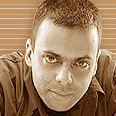
Raanan Shaked
צילום: רונן בש
We don’t have a father
Raanan Shaked’s orphanhood prompted discovery of wider national phenomenon
We don’t have a father.
I realized it by coincidence, one of these days, after I wrote a simple, unpretentious column - from the heart, as we like to say – about growing up without a father. I wrote about childhood, adolescence, and adulthood without a father figure; without the manly set of keys that allows you to access the world’s masculine centers of gravity and influence; without someone to tell you: This is the shaving cream, this is the razor, and be careful not to poke a hole in your cheek – and yes, the aftershave will burn a little, but you’ll learn to enjoy it.
That column ended badly, at least for my mailbox – usually a slim entity that makes do with little but was now suddenly overcome by a bulimia attack and collapsed under what I cautiously estimated to be seven million emails of Israelis screaming out: Me too. Same here. I too don’t have a father. Or else, I do have a father, but for me he is not a father. Or maybe he was never home when the home begged for his presence. Or else, he hit us, yelled, drank, slept, picked his nose, did not remove blackheads in a timely manner, and in general made my life, or our life, hell.
People sent me years replete with self-reflective thoughts and scores that I had no way of settling. People used my mail to clear up packages and goods stamped with the same postmark: A missing father.
I cried along with some of them and responded to others. Eventually, I gave up. One can only be happy for managing to touch them without infecting them with something.
The missing link
Yet now I know: We have no father. For some of us it’s real while for most of us it’s merely a feeling, but this insight helped me understand something broader about our situation: The missing father is the missing link in deciphering the contemporary Israeli DNA.As a state that grew up with mythological father figures imbued with paternalism and white hair, ranging from the early Ben-Gurion to the elderly Ariel Sharon (in my view, Golda Meir is also a father figure). At this time, we are all orphans seeking comfort in the reckless, hollow generation of the sons who are wasting their fathers’ inheritance; ranging from the premature Ehud Barak to the too-late Bibi.
And we have neither a father nor comfort. We also have a hysterical mother – in the form of the media – and we have nothing or nobody to lean on, someone who will put us up on their shoulders, because just like anyone else, sometimes it’s difficult for us to lift ourselves.
Indeed, sometimes one only needs to publish one personal story in order to fully grasp a national narrative.
