


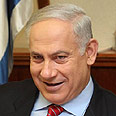
Prime Minister Benjamin Netanyahu
צילום: AP
Netanyahu’s photo album
Prime minister more concerned with photo opportunities than with substance
During Benjamin Netanyahu’s first term as prime minister, he summoned then-Finance Minister Dan Meridor to a meeting. The ties between them at the time were on the brink of explosion and eventually prompted Meridor to quit.
Meridor later said that when he arrived at the meeting, he was surprised to spot television and press photographers. Why is this needed? He wondered. After all, it’s a personal meeting. Netanyahu’s aides told him that they are merely interested in a still photograph of the two figures, without audio.
Yet when Meridor entered the prime minister’s office he saw an aide boosting up Netanyahu’s chair, while Meridor himself was given a low chair. The photo released to the media showed a giant and a dwarf.
Netanyahu is a follower of the American school of thought that believes that the way politicians are seen in photos is at times more important than what they do. Media researcher Daniel Boorstein described this notion through a dialogue between two women. One praises the other for having a beautiful child. Her friend responds: That’s nothing, wait ‘till you see the photos.
Late Prime Minister Yitzhak Rabin managed the negotiations with the Palestinians via secret diplomacy, until it matured into an interim agreement. Only then he posed for a photograph with Bill Clinton and Yasser Arafat. Netanyahu, on the other hand, first posed for a media photo at his Bar-Ilan University speech where he presented his conditions for diplomatic talks. The photographs were so good that there was no need for a real diplomatic process later.
Picture is worth a thousand deeds
Elsewhere, Netanyahu posed for a photograph at his office with opposition leader Tzipi Livni in order to inform Israel’s citizens that he is making an effort to form a national unity government. After the meeting it turned out that based on the conditions he presented for such union, he intended to form a national photography government.
The painful affair involving the negotiations for the release of Gilad Shalit were also managed through media drama, where we saw security cabinet ministers being photographed as they arrive at the Prime Minister’s Office in order to make a final decision. Today it turns out that it was merely another step in the drawn-out negotiations.
As time passes, it increasingly turns out that Netanyahu is dealing with the production of a photo album of his term as prime minister more than he is engaged in making political decisions. Media schools teach their students that a picture is worth a thousand words, but now we can add another dictum: A picture is worth a thousand deeds.
