


Frontline skiers ignore Israel-Syria hot air
Only evident tension is in faces of visitors unprepared for bone-chilling cold as they take to Mount Hermon's slopes
Israeli skiers on Sunday ignored newspaper headlines about "war with Syria" and took to the slopes of Mount Hermon, where the two countries share a frontline that saw fierce tank battles in 1973.
The only evident tension was in the faces of visitors unprepared for bone-chilling cold as they rode the ski-lift to the crest before the sun came over the top to warm the air.
There was no sign whatever of raised military alert on a border that bristles with hilltop early warning sensors, because the recent alarm was purely verbal, and Prime Minister Benjamin Netanyahu has moved to quash it firmly on Israel's side.
At the nearby Valley of Tears, where a monument in a copse of pines among the minefields marks one of the bloodiest clashes of the real war, Israeli army trenches were empty. The only tanks were old hulks, left as mementoes.
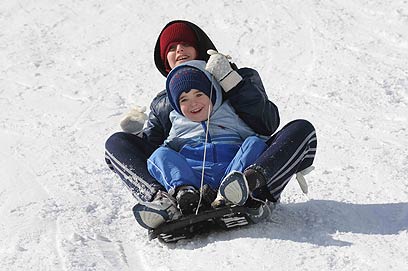
Having fun in the snow (Photo: Avihu Shapira)
Oren, a young Franco-Israeli skier who got to the mountain from Tel Aviv before dawn to enjoy the first runs with a group of friends in their 20s, said he felt "completely safe" despite the proximity of an enemy state, and political sabre-rattling.
"I think that in the past 20 years there were no special incidents except for some crazy guy or something like that. But from the security point of view it's very safe. You don't see a lot of security, you don't feel it," he said.
Mt. Hermon rises to 2,400 meters (7,874 feet), sitting astride what has been Israel's quietest enemy front for over three decades.
Syria, which has skiing not far away on the eastern slope of the range, got a reassurance on Thursday from Netanyahu that Israel wants a treaty with the Arab state to end their 60-year state of war.
The premier stepped in to cool an escalating series of exchanges, after Foreign Minister Avigdor Lieberman threatened to topple Syrian President Bashar Assad in any conflict.
Netanyahu repeated on Sunday that Israel seeks peace and is ready to negotiate without preconditions.
Cold reality
Israel rejects Syria's demand that it undertakes before peace talks to return the Golan Heights, the strategic Syrian plateau captured in the 1967 Six-Day War which dominates the territory on either side of the ceasefire line.
Its buried dangers were front-page news in Israel at the weekend when a boy had his foot blown off after straying into one of the many minefields that litter the high ground.
Lieberman's threat came after Assad had accused Israel of pushing for war. A few Israeli lawmakers urged Netanyahu to dismiss him for bellicose rhetoric, which some analysts speculated was really about the ultranationalist minister's will to rule out any notion that the Golan is negotiable.
Indirect negotiations between Syria and Israel, mediated by Turkey, broke down during the Israeli invasion of Gaza in December 2008. But senior Israeli officials believe Syria still may offer the most promising avenue for a wider peace.
On the slopes, it was all clean, cold fun. Mt. Hermon is the only ski slope within driving range of Israeli cities and while not blessed by deep Alpine powder, snow-cover is sufficient.
Israel, however, is also concerned by Syria's support – along with that of Iran – for the Shiite Hezbollah force in next-door southern Lebanon, where war erupted in 2006 and where the border remains decidedly more tense.
No such considerations spoiled the day out for hundreds of keen Israeli skiers and snow-boarders, and a group of young migrant workers from the Philippines joined in, enjoying their day off in a novel environment without trying the skis.
"It's really our first time to see the snow," said a young Filipina named Sharyl. "It's very cold!"
