



Palestinians favor bin Laden, Ahmadinejad over Hamas
Pew Research Center survey reveals mediocre support ratings for Hamas, Hezbollah among Muslim world. Saudi King Abdullah, US President Obama most popular leaders
Twenty-five Muslim countries showed only mediocre support for Israel's archenemies Hamas and Hezbollah, according to a Pew Research Center survey. The Muslim organizations received more support in Israel's neighboring countries, while only 37% of respondents in the Gaza Strip said they supported Hamas.
According to the survey, which was conducted between May 18 and June 16 of 2009, only 37% of Gaza residents, who are under direct control of Hamas, said they were in favor of the group, while 47% of West Bank residents vowed their support for the Fatah rival.
Across the border, support ratings for the Palestinian political faction varied greatly; 52% of Egyptian respondents said they backed the group, 56% expressed their support in Jordan, only 30% were in favor of Hamas in Lebanon and a mere 5% in Turkey.
Hezbollah, on the other hand received the support of 61% of Palestinians and 51% of Jordanians, while in Egypt only 43% backed the Shiite party – higher than what the Egyptian leadership was expecting following its recent public clash with Lebanese faction, after Egypt revealed a Hezbollah terror network in its territory.
An interesting finding revealed that within Lebanon only 35% supported Hezbollah – among them 98% were Shiite, while only 18% were Christians and 2% Sunni Muslims. The finding reaffirms the social cleavage between the Sunnis and the Shiites in the country.
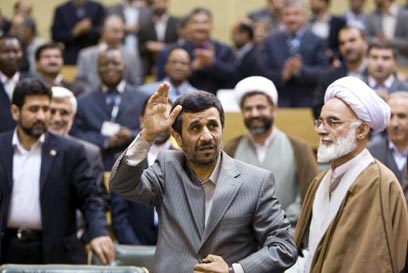
Ahmadinejad. Many enemies, many fans (Photo: Reuters)
Palestinians: Bin Laden loved like Abbas
The survey also analyzed support ratings for the regional leaders. Saudi King Abdullah ranked first with 92% support in Jordan, 83% in Egypt and 55% in Lebanon. However, despite his popularity in the Arab world, only 38% of Palestinians said they supported the Saudi Arabia Monarch.
Palestinians did however vocalize their support for Hezbollah Secretary-General Hassan Nasrallah, who received the nod of approval from 65% of residents in the Gaza Strip and 71% in the West Bank. Even in Jordan Nasrallah got a majority approval of 56%, while in Egypt the figure was slightly more modest at 34% -- which still represented a substantial pool of proponents.
At home, Nasrallah faced a harsher reality – with only 37% of respondents who said they backed the Shiite leader – among them 97% were Shiite and only 2% were Sunni.
Palestinian President Mahmoud Abbas showed a decline in popularity compared with a similar survey conducted in 2007; only 33% of Egyptian respondents expressed support for the Palestinian leader, compared with 67% in 2007.
Among Palestinians, the decline was not as sharp, with 52% support rating compared with 56% in 2007.

Barack Obama. Wins US popularity contest (Photo: Reuters)
Obama preferred to Arab leaders
Iranian President Mahmoud Ahmadinejad might be the most hated and ridiculed figure in Israel and the West, but among Palestinians he retained his popularity, with 45% expressing their support.
Second on his list of fans was Indonesia – the largest Muslim country in the world, where 43% declared their fondness to the Persian leader. Other countries in the region were not as forgiving; only 32% of Lebanese and Jordanians said they supported the controversial president, while only 26% of Egyptians and 17% of Turkish said he had their back.
Leader of Al-Qaeda global terror group Osama bin Laden also showed declining popularity, while his strongest supporters could be found in Nigeria (54%) and among of Palestinians (51%), which according to the survey, identify with his worldview.
In the rest of the Muslim countries, Osama bin Laden is not as loved; only 28% support rating in Jordan, 23% in Egypt, 18% in Pakistan, 4% in Turkey and a mere 2% in Lebanon.
Unlike the divided public opinion vis-à-vis Arab leaders, US President Barack Obama maintained high ranks across the board with an 81% support rating in Nigeria, 71% in Indonesia, 69% among Israeli-Arabs and 65% among Sunni Lebanese.
The survey conductors emphasized the Obama's support ratings were significantly higher than his predecessor, George W. Bush.
