


Beinish: We mustn't fear inquiry into Gaza war
In meeting with high school students in Haifa, Supreme Court president addresses possibility of independent Israeli commission of inquiry following Goldstone Report. 'I believe many things will turn out to be exaggerated, but I don't really know,' she says
Talking to 12th graders at the Hebrew Reali School in Haifa on Monday, Justice Beinish said, "If things should be examined, then they should be examined. I believe many things will turn out to be exaggerated, but I really don't know. I think the State of Israel is strong enough not to fear an inquiry. It's not by job to decide who should do this – the State or the army."
Omri Magen, a 12th grader studying in a military boarding school, asked the judge about her stand as to "a military commission of inquiry" in response to the Goldstone Report. The Supreme Court president corrected him, saying that the argument was between those supporting a state or civil commission of inquiry and those supporting a military probe only.
"I am not taking a stand on such a controversial issue," she said. "I am saying that in any framework decided as required – and perhaps it is required with such serious allegations – I believe Israel has nothing to fear."
Israel recently submitted to the United Nations an official response to the Goldstone Report, which accused the Jewish state of committing war crimes in Gaza. The response revealed that Gaza Division Commander Brigadier-General Eyal Eisenberg and former Givati Brigade Commander Colonel Ilan Malka were disciplined following the strike on an UNRWA facility for "exceeding their authority in a manner that jeopardized the lives of others".
'Talkbacks inciting against judges'
Beinish went on to discuss the recent attacks on the legal system, accusing talkbackers on internet forums of inciting against Israel's judges. She spoke several hours after the car of Haifa District Court Judge Moshe Gilad was set on fire and about two weeks after she was hit by a shoe hurled at her during a court session.
She said that the torching of Judge Gilad's car was an escalation against the government institutions, "and especially against the court, which is supposed to be detached from all this."
She noted that the incident's details would only be known after the completion of the investigation, but that "there is no doubt that the language of power and threats speaks for itself and has spread everywhere."
She slammed the criticism, which she called "the inciting tongue", as well as the talkbacks and their aggressive language. "This phenomenon must be uprooted. We must address the inciting tongue. Look at the talkbacks," she said.
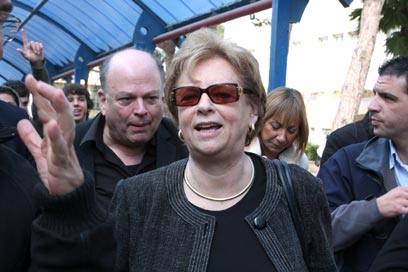
Beinish with her husband Yehezkel (Photo: Avishag Shear-Yeshuv)
The Supreme Court president went on to speak about the violence in the Israeli society. "The reality which we live in and deal with is not easy. Throughout its existence, Israel has been dealing with security problems. The gaps between the different classes and groups in the Israeli society have not been reduced and may even be growing.
"All this is joined by a deep concern over the phenomena of violence, heavy crime, fatal road accidents – which all express disrespect for human life. And I fear deeply that the society in Israel has gotten used to viewing these phenomena as part of the reality of our life, as if this is our fate."
'Criminal terror threat'
As for the sense of insecurity, she said that "sometimes there is a feeling that an innocent person, leaving his house into the city's street, beach, restaurant or any other event, cannot be sure that he will return safely – and not only because of the terror threats, but also because of the criminal terror, which lurks close to every person, women, children and elderly people, even in their own home.
"There is another phenomenon which is just as dangerous – the loss of trust in our governmental institutions, due to the uncovering of corruption and the exposure of faulty social norms."
According to Beinish, a combination of these phenomena "sometimes evokes a spirit of gloominess on the public, and perhaps of fear of helplessness. There is also an atmosphere of loss of trust in all the governmental institutions, doubtfulness in regards to the ability to fulfill the governmental roles and duties, and due to the exposure of different affairs – there are even suspicions that corruption is infiltrating the governmental institutions.
"I am here to tell you that we must not give in to this atmosphere. The governmental institutions set up as part of our government system are the hoops the democratic regime is built on. We must strengthen and improve, we must act in all areas – education, welfare and law – in order to remove flawed phenomena, support the different circles with the social means, but with the faith and understanding that the solutions exist among us."
Responding to a student's question about former Justice Minister Daniel Friedmann's stand against judicial activism, the Supreme Court president said the former minister had sought to take the Israeli legal system 40 years back. "But life in Israel has changed in the past 40 years," she noted.
She also responded to a question about the High Court ruling on Route 443, noting that the area was expropriated from Palestinians in order to pave the road by the State, which she herself represented as an attorney at the time, "for the residents' welfare." Beinish noted that she travels on the road regularly.
