


NATO secures 'key objectives' in Afghanistan
Bombs slow US advance in Taliban-controlled town during largest offensive since 2001 invasion of Afghanistan; 5 soldiers killed in area Saturday
Bombs and booby traps slowed the advance of thousands of US Marines and Afghan soldiers moving Saturday through the Taliban-controlled town of Marjah, NATO's most ambitious effort yet to break the militants' grip over their southern heartland.
NATO said it hoped to secure the area in days, set up a local government and rush in development aid in a first test of the new US strategy for turning the tide of the eight-year war. The offensive is the largest since the 2001 US-led invasion of Afghanistan.
The Taliban appeared to have scattered in the face of overwhelming force, possibly waiting to regroup and stage attacks later to foil the alliance's plan to stabilize the area and expand Afghan government control in the volatile south.
NATO said two of its soldiers were killed in the first day of the operation – one American and one Briton, according to military officials in their countries. Afghan authorities said at least 20 insurgents were killed.
Homemade bombs, booby-traps
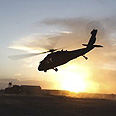
More than 30 transport helicopters ferried troops into the heart of Marjah before dawn Saturday, while British, Afghan and US troops fanned out across the Nad Ali district to the north of the mudbrick town, long a stronghold of the Taliban.
Maj. Gen. Gordon Messenger told reporters in London that British forces "have successfully secured the area militarily" with only sporadic resistance from Taliban forces. A Taliban spokesman insisted their forces still controlled the town.
In Marjah, Marines and Afghan troops faced little armed resistance. But their advance through the town was impeded by countless land mines, homemade bombs and booby-traps littering the area.
Throughout the day, Marine ordnance teams blew up bombs where they were found, setting off huge explosions that reverberated through the dusty streets.
The bridge over the canal into Marjah from the north was rigged with so many explosives that Marines erected temporary bridges to cross into the town.
"It's just got to be a very slow and deliberate process," said Capt. Joshua Winfrey of Stillwater, Okla., a Marine company commander.
Lt. Col. Brian Christmas, commander of the 3rd Battalion, 6th Marines, said US troops fought gun battles in at least four areas of the town, including the western suburb of Sistani where India Company faced "some intense fighting."
To the east, the battalion's Kilo Company was inserted into the town by helicopter without meeting resistance but was then "significantly engaged" as the Marines fanned out from the landing zone, Christmas said.
Marine commanders had said they expected between 400 and 1,000 insurgents, including more than 100 foreign fighters, to be holed up in Marjah, a town of 80,000 people which is the linchpin of the militants' logistical and opium-smuggling network in the south.
'We can't even walk out of our own houses'
Shopkeeper Abdul Kader, 44, said seven or eight Taliban fighters, who had been holding the position where the Marines crossed over, had fled in the middle of the night. He said he was angry at the insurgents for having planted bombs and mines all around his neighborhood.
"They left with their motorcycles and their guns. They went deeper into town," he said as Marines and Afghan troops searched a poppy field next to his house. "We can't even walk out of our own houses."
Elsewhere in the south, three US soldiers were killed by a bomb in an attack unrelated to the operation, NATO said.
Once Marjah is secured, NATO hopes to quickly deliver aid and provide public services in a bid to win support among the estimated 125,000 people who live in the town and surrounding villages. The Afghans' ability to restore those services is crucial to the success of the operation and in preventing the Taliban from returning.
Maj. Gen. Nick Carter, the top NATO commander in the south, said coalition forces hope to install an Afghan government presence within the next few days, bringing health care, education, electricity and other public services to win the allegiance of the townspeople.
Teams of international development workers and Afghan officials are ready to enter the area as soon as security permits. A deputy district chief has already been appointed for Marjah and government teams have drawn up maps of where schools, clinics and mosques should be built.
