


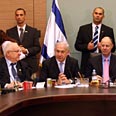
Knesset's Foreign Affairs and Defense Committee
צילום: גיל יוחנן
IDF: Sanctions will have limited effect on Iran
Senior Military Intelligence officer tells Knesset's Foreign Affairs and Defense Committee that applying international sanctions against Islamic Republic may take months, prove only partially effective
Prime Minister Benjamin Netanyahu and Defense Minister Ehud Barak may be pushing for paralyzing international sanctions on Iran, but according to Military Intelligence, such sanctions may prove less effective than expected.
A senior Military Intelligence officer, speaking before the Knesset's Foreign Affairs and Defense Committee on Monday, said that "it is likely that applying sanctions on Iran may take weeks and even months.
"We believe that such sanctions will be only partially effective, and that while they may affect Iran as a nation, they will have little impact on its nuclear program."
Last week, Head of Military Intelligence Research Division Brigadier-General Yossi Baidatz said that "while the potential for a coup in Iran exists, there is still a big difference between the riots we've seen so far and toppling the regime.
"The Iranian regime is far from collapsing and anyone expecting anything like that in the near future will be disappointed," he said.
Barak, who also addressed the issue at the committee meeting, said that while Iran did not pose an existential threat to Israel at this time, it had the potential of becoming one – a potential Jerusalem was working to thwart.
The senior officer speaking before the committee also reviewed the Palestinian Authority's activities in the international arena, saying the PA was continuing to work against Israel within international organizations.
As for the recent clashes at Temple Mount, the officer explained that Hamas was most likely the inciting force behind the riots, "as the PA has no interest in encouraging such things."
