


Bereaved parents volunteer with IDF
They lost what is most dear to them, cope with bereavement by giving to IDF. 'I feel I'm doing something, even if it's just a little,' one of parents says
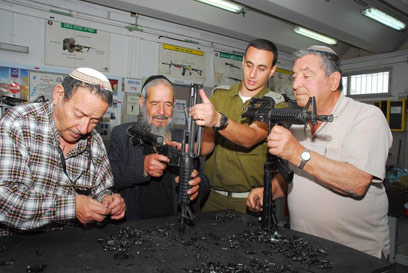
They lost what was most dear to them on the battlefield, in training accidents or in operations, but despite the mourning and bereavement, they feel the need to maintain a connection with the IDF. Each Wednesday a group of bereaved parents and widows, most above the age of 60, present themselves at the armament branch of the Southern Command in Beersheva. After greeting the young soldiers, they go to work in the various departments in order to continue – if only on a symbolic level – the work of their sons who never returned.
"I feel close to the army, where my son fell," says Yehoshua Attiya, 82, who lost his son Zvi in the Yom Kippur War. Attiya, despite his advanced years, does not miss the opportunity to contribute to the IDF. He began this habit two years ago, at the Tzalim base, repairing lighting fixtures among other things. Now, in the Natan camp, he is with the base's arms. "We do all kinds of things, sorting through parts, checking stock," he says.
His son Zvi, 23 years old at the time he was killed, grew up in Moshav Sharsheret near Netivot. "He was a bright kid who loved soccer," his father recalls. "But the Sabbath was the most important thing for him, even if it meant giving up the soccer."
Zvi joined the armored corps in the summer of 1970. "Exactly two months after he was released," his father says, "the Yom Kippur War broke out and he wanted to be at the front. At that time he had already planned his life and was even ready to get married. But these plans were cut short."
The soldiers at the base look at Attiya respectfully, but for him this isn’t the main issue. "I do what I can, I'm not looking for respect, I'm willing to give even more. Every day I come gives me a feeling that I'm doing something, even if it's just a little, for the army. In the same place my son was."
"They've become part of us – for them it’s maintaining a connection with the army, and for the soldiers here it's a fine example," the unit commander Colonel Shahar Gilad says. He admits this is a special project. "These great people are part of us – they know the division's way of life, they are present at the ceremonies and even at parties, and they even join us for trips."
'Really proud of it'
There are also women volunteering, two of them widows. Roza Savag (65) lost her husband Amos Eliyahu after the Six-Day War in the Sinai. He was just 30 years old. When his widow retired, she knew she wanted to volunteer, and when the opportunity arose, she jumped at it.
"I have already done various kinds of work, from repairing antennas, to helping in the kitchens, to dealing with screws. I don't know how much this really helps the army, it might even be a pain," she says with half a smile, "but I'm really proud of it. Sometimes the soldiers say that when I'm here they manage to do much more. It's really important to me. I didn't serve in the army, and now it's as if I'm making up for it, both for me and for my husband."
She also says that female soldiers often talk to her, which she finds very moving. For the soldiers at the base, it is just as moving. According to Colonel Gilad, this group's contribution to the base is much greater than the volunteers think.
"Each has a different task, according to what he has requested and the things he likes," he says. "But their contribution is much more than this. Some of the soldiers here have difficult backgrounds. They see these people who have lost that which is most dear to them, and understand something about this state."
