


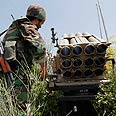
'We no longer scare our enemies'
צילום: AP
Israel’s eroded deterrence
Op-ed: Rockets in Eilat, Lebanese provocation result of weakness detected by our enemies
Something happened around here. Our enemies, which possess sensitive detectors, apparently sensed that things are changing. They no longer fear the IDF. Missiles land in the Gaza region and in Ashkelon, rockets explode in Eilat, and even the Lebanese army dares to provoke the IDF.
We should not be surprised to see terror attacks in Judea and Samaria in the coming days, as well as a rocket barrage from Hezbollah and possibly an infiltration from Jordan. Even Syria may not remain idle, while an attack on a Jewish center somewhere in the world is certainly a reasonable scenario. Not all of these attacks will cause casualties, and some may be thwarted in one way or another and we’ll never hear about it.
What is the common denominator shared by the latest attacks and the ones waiting around the corner? A logical answer is that we no longer scare our enemies. The IDF’s shadow does not make them shiver and break out in cold sweat. They interpret Israel’s political and diplomatic weakness in the international arena as military and security weakness. They estimate that a state that caves in to a UN demand for a probe into the Turkish flotilla would not dare respond forcefully to acts of sabotage and attacks.
In other words, Israel’s deterrence may have been eroded too much. Our enemies may again question the IDF’s ability and determination to act. The problem is that should we continue to let them miscalculate, they may escalate their actions to a point that would require us to respond in full force – and risk escalation into war, which we do not want.
If that’s the case, how should we act? The restrained conduct adopted by policy makers may prove beneficial, assuming that all the recent events are not linked and do not aim to challenge a diplomatically weak Israel. We must show restraint until the overall picture becomes clear and the intentions of “axis of evil” leaders become obvious.
Restraint interpreted as fear
However, there’s a catch here. In this cursed region, exaggerated restraint is interpreted as weakness and fear. The planned killing of an IDF battalion commander elicits no response? Which of our neighbors would believe that we are strong enough to show restraint?
Deterrence needs to be maintained, boosted, and occasionally demonstrated. We may soon reach the day where the IDF is forced to showcase its intention and ability to deter via a powerful, painful response. However, such response should not come from the gut. We must not respond rashly to painful attacks and we must not see every Qassam attack prompting a strike on a Gaza tunnel.
Boosting Israel’s image of deterrence requires advance, thorough planning, careful selection of the most suitable timing and target, and a sharp, rapid maneuver (rather than a rolling, cumbersome operation.) Such operation must also be adapted to hostile media and global public opinion.
The eroded deterrence reflected through the recent events holds military implications, but also diplomatic ones. The sensitive arena at this time is the direct talks with the Palestinians; Israel must approach the negotiations with an image of decisive willingness and a strong sense of action.
Policy makers must be debating between a policy of containment and restraint, and a policy of boosted deterrence. This isn’t a crisis yet, and there’s time to plan, take wise decisions, facilitate the political and media infrastructure, and prepare public opinion in order to restore our deterrent power.
Shmuel Gordon, an Air Force colonel (res.), holds a Ph.D. in strategic studies and international relations
