


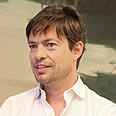
Berggruen: I won't invest in Israel till I see results
After completing huge purchase of German retail chain, real estate tycoon declares will invest $3 billion in realty by fall, but is cautious when it comes to Jewish state: 'We wanted to create a trend here, but at the end of the day we were left behind'
Despite its abrupt conclusion, the interview with Berggruen was conducted at a fast pace. The man who retains his status as the wealthiest homeless person in the world, traveling around the world in his private plane from one luxury hotel to another, tells us, for example, about his plans for the coming fall to purchase real estate assets in Europe and the United States at the astronomical sum of $3 billion.
The interview was conducted a week after Berggruen signed a huge deal, purchasing German retail giant Karstadt, which went bankrupt last year. The retailer has an annual trade volume of 5 billion euro, operates 120 supermarkets and employs upwards of 25,000 people.
Berggruen and Karstadt's German deal
Details of the Karstadt acquisition remain a mystery. As befitting a deal between a German tycoon and German government workers, the value of the deal, believed to be one of the biggest in the European real estate market in recent years, have not yet been disclosed.
Based on talks with Berggruen's representatives, the surprising move appears not to be his first in the retail market. In the past, Berggruen, who usually finds and invests in real estate companies in financial crises with a potential for quick recovery, controlled South American optic and soft drink retail chain groups.
The conversation with Berggruen quickly shifts to his dealings in Israel, and we were disappointed. Since his first visit to the country in 2005, Berggruen has returned at least once a year and almost always grants interviews to the local financial press. Previously he sounded much more certain of his investments in Israel. This time his tone is different.
“To tell you the truth, I have no intention of investing here until I see the results of the Meier Project on Rothschild,” he says. “For years I reviewed various investments in Tel Aviv and Jerusalem, but I always went back to look for proposals that could become unique projects in central Tel Aviv.
"I love cities and believe that if you're in the real estate business, you have to be in the middle of the most important cities in the country. The proceedings here led me to believe that I should wait to see what happens with our first fundamental project here, and only find a new project after that.”
2 deals in 10 minutes
Berggruen has made two major investments in Israel – the first was purchasing property at the corner of Rothschild Boulevard and Allenby Street in Tel Aviv, and the second was the acquisition of a collection of buildings slated for historic preservation on Nahalat Binyamin, in Tel Aviv.
“These two deals were finalized ten minutes after they were presented to me,” he says. “I sat in a cafe opposite the property on Rothschild and Yigal Zemah (CEO of Berggruen Residential) told me that I could buy it and build a tower, but that I must act fast. So we acted very fast.”
But since that fast move, everything in Tel Aviv has moved slowly for Berggruen – too slow for his taste. The story of the Meier Tower on Rothschild, which is owned by Berggruen, is a sad example of the way local bureaucracy hinders real estate initiatives.
Berggruen purchased the land for the intended tower in 2007 for $30 million. Following excavation work in 2008, stores were cleared from the adjacent covered passageway and it was destroyed. The result: The company only obtained a building permit at the beginning of this year.
The fact that the light rail was originally supposed to run along the Meier property made the process of obtaining building permits exhausting, even by Tel Aviv standards. Berggruen chooses to ignore the fact that the same bureaucracy granted an additional ten floors for his tower, which will be 40 stories.
“I tried to create a new trend here, to set the real luxury construction branch in motion,” Berggruen says. “The fact that Richard Meier, one of the greatest architects in the world, came here, after successfully upgrading the skyscraper market in Manhattan in the 1980s, should have brought about a change, but the change began and we were left behind.”
By the end of the first quarter of this year, 35% of the tower had been sold for NIS 278 million. When Berggruen was asked about his relations with Israeli businessmen and what he thinks of them, he answers with a half smile: “Yesterday we were here at dinner with our Israeli partners (Zachi and Ido Hajaj, who own the Hajaj Group), and I told them that I was worried that we still hadn't found anything to argue about, which always happens here. Eventually we decided to argue about the kind of food we would order.”
Berggruen, who was educated in Europe, admits that the approach that everything in business must be argued is not his style. “I force myself to adapt to your space,” he says.
Agriculture? 'I was too ambitious'
About a year ago, Calcalist reported of Berggruen's ambitious plan to become a leading player in the agriculture market. This week he sounded less enthusiastic. “Perhaps I was too ambitious. It is a business that moves slowly, and I embarked on it just when the financial crisis began. At the time, presents were being placed on my table – meaning, fantastic proposals for investing in different fields, particularly real estate.”
At present he has a group in Australia that operates in the field of agriculture, but activities in Israel have been terminated. When asked whether this is a good time to invest in the financial markets or in real estate, Berggruen answers: “I am a bad financial investor. I prefer tangible things. I believe that there are many properties today that meet my criteria for investment – business is in trouble – the markets in which there is a high demand for these properties, and supply is relatively weak.”
Father was friends with Picasso
Nicolas Berggruen, 48, was born to a French mother and a German-Jewish father named Heinz. His father, who was friends with Pablo Picasso, became one of the most important art dealers in the world after World War II, amassing a fortune of some $2.2 billion.
His son invested most of this fortune in real estate in Europe and the United States. Berggruen began doing business in Israel in 2005, following a brief visit, during which he decided to purchase property on Rothschild Boulevard in Tel Aviv from British billionaire Leo Noe for $30 million.
To build the tower on the property, he recruited one of the greatest architects in the world – Richard Meier. He also purchased buildings for historic preservation on Nahalat Binyamin Street in Tel Aviv, which he sold a year later, and founded an Israel company called Berggruen Residential.
Last year he sold half of the company for NIS 60 million (about $60 million) to a group led by Yitzhak and Ido Hajaj. In recent years Berggruen has tried to invest in alternative energy and agriculture in various countries, including Israel, but his activity in these markets is currently quite minimal.
Shirly Sasson-Ezer contributed to this report
- Follow Ynetnews on Facebook
