


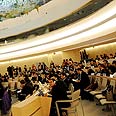
UN Human Rights Council
צילום: AFP
Meeting the challenge
Op-ed: UN Human Rights Council’s president addresses criticism of body’s work
Since the adoption of the Universal Declaration of Human Rights over 60 years ago, we have witnessed significant advancements in terms of norms and standards, at the national, regional and international levels, that states are expected to adhere to. Yet, we need to do much more to ensure full respect for human rights throughout the world.
All actors – state or non-state – have an important role to play in this noble endeavor. Ultimately, we need to ensure that states are both legally and morally compelled to fully engage in the promotion and protection of all human rights and fundamental freedoms. Otherwise, these universal principles will remain pious hopes.
That is why much hope and great expectations have been placed in the United Nations Human Rights Council. That is why the Council, in entering its fifth year of existence, needs to take time to review its successes as well as its shortcomings and see how it can do better in justifying these hopes and expectations (Resolution 60/251 of the United Nations General Assembly which created the Human Rights Council states that it has to “review its work and functioning five years after its establishment.”) To see how it can improve its functioning to fulfill its commitments to universality, impartiality, objectivity, non-selectiveness, transparency and accountability.
There are those who express concerns about politicization within the Council. Those who say that it is more sensitive to certain issues than others or more critical of certain countries than others. There are also many who feel that the Council could do better in addressing chronic human rights violations and emergencies. The Council must take heed of these views and comments.
We have to accept that politics will always be part of the work of a State-driven body (notably, the Human Rights Council is comprised of 47 members elected by the full UN membership.) That we, states, do not always share the same view on every single issue, that we have sometimes divergent priorities and opinions. However, the Council has to seek ways of avoiding unnecessary politicization, of enhancing constructive dialogue across regional groups and establishing a common agenda focused on the promotion and protection of all individuals’ and peoples’ rights.
It is imperative for the Council to demonstrate that it will address, in an even-handed manner, all situations, all gross and serious human rights violations, wherever they take place. It is imperative that discussions taking place in the conference room are translated into effective actions and have a meaningful impact on the lives of people.
No country can claim to have a flawless human rights record. No country is above international scrutiny. One of the successes of the Council is the very innovative Universal Periodic Review mechanism, which examines the human rights record of all states, from the biggest power to the smallest island, and leads them to make strong commitments such as to raise the age of juvenile penal responsibility, abolish the death penalty or introduce a moratorium on executions, set up national action plans to combat poverty and illiteracy, fight against impunity and to better combat violence against women and children.
As the Council embarks on its review process, it has a unique opportunity to “recalibrate” its work to see where improvements can and should be made. Critical thinking and constructive suggestions are needed and welcome. State representatives have a central role to play. So does civil society: contributions by actors such as non-governmental organizations (NGOs), human rights defenders, media and academic institutions are instrumental to the functioning and betterment of the Council.
The review is not about reinventing the wheel, nor about creating a new structure – the Council is still a young body. It is an opportunity to take advantage of good practices and to address gaps in order to make the Council more efficient and effective in implementing its mandate. An opportunity to forge stronger partnerships with all mechanisms, institutions and NGOs which are vital components of the global human rights architecture.
The review of the Council is an opportunity to take concrete steps to better meet the challenge of advancing the fundamental rights of all individuals and peoples, regardless of their nationality, race, religion or creed.
Ambassador Sihasak Phuangketkeow, President of the UN Human Rights Council
- Follow Ynetnews on Facebook
