


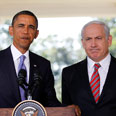
Obama and Netanyahu
צילום: AP
Rare opportunity for Bibi
Op-ed: In wake of midterm elections, Obama to be more pragmatic, appreciative of Israel
Part 1 of article
America’s main problem today is what Bob Dylan referred to in his famous song, “The times, they are a-changin’.” Obama’s America in 2010 is a different US, with economic, military, diplomatic, and demographic tsunami waves hitting its shores. The problems faced by any president these days have a global dimension, ranging from terrorism to technology, economics, production, and the monetary system – even the dollar is no longer the dominant currency in global markets.
What in the past could have been summed up with the well-known dictum “It’s the economy, stupid,” and was a true challenge both for Presidents Clinton and George Bush Sr., can today be paraphrased as “It’s the globalization, stupid.”
According to Forbes, the US president is no longer the world’s most powerful man, but rather, this honor is reserved for China’s president. That’s how things are when “times are a-changin.’” Immediately following the midterm elections, Obama headed to the rising economies in Asia. The trip to Indonesia was not only a homecoming for Obama: Resolving the unemployment problem and bringing production back to America requires trade and export agreements with Asia’s rising giants. The president’s leadership challenge is to create a new economic order, through difficult negotiations and while facing harsh competition on global markets.
Yet it’s still too early and exaggerated to eulogize Obama. Two years is almost an eternity in politics. As the first “Internet president” in the era of globalization, he already proved his ability to ride the tsunami waves, identify errors, and responds quickly.
Chances are that despite the domestic failure, Obama will not retreat from his plan to bring a framework deal on the establishment of a Palestinian state during his term in office. His agenda and ideology, in addition to his commitment and desire to validate the Nobel Prize he was awarded, indicate that he will continue to press for realizing his policy and vision, even if under the circumstances he decides to be a one-term president.
We must keep in mind that not everything is about domestic politics. The peace process constitutes a central axis in America’s Mideastern strategy and the lever for forming a moderate Sunni coalition that would create a united front and respond to Iran’s nuclear program and hostile takeover attempts in Gaza, Lebanon, Iraq and elsewhere.
The leadership tests faced by Obama at home, along with the broad bipartisan and public support for Israel, create a rather rare window of opportunity for Netanyahu to upgrade Israel’s status in managing the negotiations with the US.
In the history of the peace process, which has known ups and downs in the past 30 years, early understandings between Israel and the US were always the most important component in any negotiated agreement. Today, Obama is asking Israel to play on his team and in line with his game plan. It appears that in the game’s second half he will be more pragmatic, more attentive, and more appreciative of Israel’s importance, not only in advancing the peace process but also in reinforcing America’s national security interests in the Middle East.
Part 2 of analysis to be published Monday evening
- Follow Ynetnews on Facebook
