


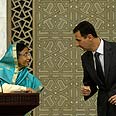
Patil with Assad in Damascus
צילום: רויטרס
A friendship in progress
Op-ed: Despite closer ties, ‘Muslim factor’ still undermines India-Israel relationship
The support expressed for Syria’s sovereignty on the Golan Heights by Indian President Pratibha Devisingh Patil during her state visit to Damascus made the headlines of Israeli newspapers a few weeks ago. However, President Patil’s statement is hardly significant and surprising in itself.
Although the president of India is theoretically the head of state and supreme commander of the Indian armed forces, the role is essentially ceremonial. In practice, it is the Council of Ministers and, in particular, the Indian prime minister that effectively govern the country.
Also, the backing by India’s president of Syria’s claims over the Golan is no startling news. Indian leaders have consistently called for Israeli withdrawal from all occupied territories, including the Golan Heights, and President Patil is a member of the Indian National Congress, a party traditionally very supportive of Palestinian and Arab claims. In fact, even senior representatives of the Bharatiya Janata Hindu nationalist party (BJP), far more sympathetic to the Jewish state, have upheld, although in less overt terms, Syria’s claims over the Golan Heights.
The visit to Syria of India’s President Patil, and her statement at the joint press conference with Assad, do, however, highlight several important and rather problematic features of the Indo-Israeli relationship.
First and foremost, they expose Israel’s inability, yet, to translate the progress achieved in bilateral relations since normalization into achievements on the multilateral front. Indo-Israeli diplomatic and political ties have substantially improved and cooperation has greatly expanded in the military sphere, as well as in agriculture and in science and technology, among other sectors. But it has proved difficult for Israel, not to say impossible, to gain explicit Indian diplomatic and political support in the regional and international arenas.
It is true that India has toned down its rhetoric toward Israel in the United Nations. In particular, it has stopped participating along with Muslim countries in the active promotion of resolutions adverse to Israel. Still, for the time being India’s voting records and speeches at the UN General Assembly on issues related to the Arab-Israeli conflict remain resolutely in favor of Arab countries.
Disappointment over the lack of progress achieved in Indo-Israeli diplomatic and political ties goes beyond the multilateral level. Even though bilateral visits and agreements between the two countries have greatly increased since normalization, there have been very few visits of top Indian government officials to Israel. To date, no Indian president or prime minister has come to Israel.
Creative approach needed
Prime Minister Ariel Sharon’s visit to India in 2003 was expected to pave the way for a reciprocal visit of Prime Minister Vajpayee. However, visit never came about, although Vajpayee had consistently expressed his government’s and political party’s sympathy for the Jewish state, and had greatly contributed to strengthening and expanding ties with Israel.
Prospects of an Indian prime minister coming to Israel have become even dimmer since the Congress party returned to power in 2004. In contrast, Indian leaders regularly visit Gulf and other Mideast countries. President Patil returned recently from a state visit to the United Arab Emirates and Syria. Prime Minister Manmohan Singh visited Qatar and Oman in 2008, and Saudi Arabia last year.
To a large extent, it is the so-called “Muslim factor” that hinders the development of closer diplomatic and political ties between India and Israel. The Muslim factor also drives Indian efforts to keep relations with Israel away from the glare of publicity.
Externally, the Muslim constraint relates to India's interdependence with the Middle East. India’s Israel policy is guided by fears to hurt close ties and strategic interests with the Muslim and Arab world, rather than real interest in or concern with the Arab-Israeli conflict.
In its internal dimension, the Muslim factor refers to the constraints imposed by India's sizeable Muslim population. India is home to about 150 million Muslims, the world’s second largest Muslim population after Indonesia and one of the largest Muslim-minority populations worldwide. Many in the Indian political establishment are still convinced that India has to be careful when dealing with Israel, lest the parties in power will lose Muslim votes.
In recent years new fears have also surfaced that a segment of India’s Muslim population may be drawn to Islamic radicalism coming from outside India, and that a too visible and friendly relationship with Israel may hasten such developments.
India will likely continue to support Palestinian and Arab claims in the years to come. However, there is no reason to believe that the weight of the Muslim factor on India’s Israeli policy may not be lessened in the medium to long term. We can succeed in finding creative ways to address this constraint. The Israeli Embassy in New Delhi has engaged in the past year a series of efforts to reach out to the Muslim community in India. Such a program, along with other similar initiatives, should be encouraged.
Arielle Kandel, a fellow at the Jerusalem-based Jewish People Policy Institute, specializes in Indo-Israeli relations
- Follow Ynetnews on Facebook
