


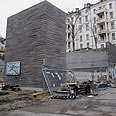
Synagogue monument in Germany
צילום: דני שדה
Tributes aren’t enough
Op-ed: European leaders commemorate Shoah but do little to combat modern genocide threats
January 27th marks the annual United Nations-designated International Holocaust day commemorating the liberation of Nazi extermination camps. On that day, Continental Europe will once again hold a host of remembrance events, which, in Germany and Austria at least, have come to embody a kind of repetitive motion disorder. In short, these remembrances have become compulsive rituals that have done little to induce European political leaders to combat modern genocidal actions.
That helps to explain the Austrian Jewish community’s precedent-setting decision last year to walk away from the annual Mauthausen concentration camp commemoration event held in the Austrian parliament. Dr. Ariel Muzicant, the president of the 7,500-member Jewish community, justified his boycott by saying Iranian Foreign Minister Manouchehr Mottaki's most recent visit to Austrian Foreign Minister Michael Spindelegger was "the straw that broke the camel's back."
According to Muzicant, his "silent protest" was directed at Austria’s pro-Iran trade policies, including foreign minister Michael Spindelegger, who in April 2010 cordially welcomed former Iranian Foreign Minister Manouchehr Mottaki in Vienna. Mottaki was a key speaker at the infamous Tehran Holocaust-denial conference in 2006, attended by a motley crew of European neo-Nazis, radical political Islamists, and David Duke, the former head of the Ku Klux Klan in the United States.
Putting aside Iranian president Mahmoud Ahmadinejad’s oft-repeated desires to obliterate Israel, a fellow member of the United Nations, the Iranian regime continues to persecute ethnic, religious and sexual minorities at home. Iran’s treatment of lesbian, gay, bisexual and transgendered persons is particularly atrocious. Iran outlaws all same-sex activity, punishing male same-sex intercourse with the death penalty and lesbian sex with 100 lashings for the first three instances, followed by execution.
Massive disconnect
And that’s only the beginning. Take the example of Iran’s peaceful Baha’i religious community, whose adherents have faced Stalin-like show trials, hundreds of executions, and radical economic and political discrimination since the Islamic Revolution of 1979. Dr. Wahied Wahdat-Hagh, an Iranian-German Baha’i, has systematically documented the genocidal acts targeting his community.
But German members of parliament have been eerily silent about Iran’s repression of the Baha’i, sexual minorities, women and trade unions, as well as Iranian Holocaust denial, and the country’s notable lack of free speech. Just last October, German parliamentary representatives from the Green Party, Left Party, Social Democrats, Christian Social Union and Christian Democratic Union met with Gholam-Ali Haddad-Adel, the head of Iran’s parliamentary cultural committee, who famously supported the fatwa calling for the murder of British novelist Salman Rushdie.
German lawmakers also met with Mohammad-Javad Larijani, head of the Iranian human-rights council, who denied the Holocaust during a Mideast security conference sponsored by the German Foreign Ministry close to Berlin’s Holocaust memorial in 2008 in the heart of Berlin’s government district.
Though Christian Social Union delegation head Peter Gauweiler and his fellow parliamentary colleagues, Monika Grütters of Chancellor Angela Merkel’s Christian Democratic Union, Luc Jochimsen from the Left Party, Claudia Roth from the Green Party, and the Social Democrats’ Günter Gloser have frequently participated in Holocaust remembrance events in the German Bundestag and across the country, they chose not to criticize the behaviors of their hosts in Iran.
According to its statistics, the Auschwitz museum saw a record number of visitors in 2010. While Europeans continue to educate their children about the Holocaust, and the memorial devoted to the six million murdered European Jews attracts growing attendance in Berlin, European political leaders continually fail to call genocide by its name and confront the Iranian regime over its grotesque Holocaust denial.
Sadly, there remains a massive disconnect between the steady stream of Holocaust remembrance events in Europe and the diplomatic and political realities. In perhaps the most emasculating episode in recent diplomatic history, openly gay German foreign minister Guido Westerwelle told the tabloid Bunte last year that he did not take his partner with him to Saudi Arabia or other Islamic countries, because “we want to encourage the idea of tolerance around the world, but we don’t want to achieve the opposite either by acting imprudently.”
Not one lifetime after the Holocaust, can the German foreign minister truly find no fault with those who claim cultural differences allow them to engage in lethal homophobia and persecution of minority groups?
Commemorating the evils of the Holocaust is easy. Expunging genocidal acts and plans today takes courage and concrete action, but is all the more necessary.
Benjamin Weinthal is a Berlin-based Journalist and fellow at the Foundation for Defense of Democracies
- Follow Ynetnews on Facebook
