


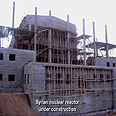
Site bombed at al-Kibar
צילום: AFP
4 nuclear sites found in Syria
Satellite images show Damascus established four facilities to accompany reactor bombed in 2007
WASHINGTON – Syria established four additional nuclear facilities aside from the one bombed by Israel in 2007, the US Institute for Science and International Security (ISIS) reported late Wednesday.
The report, which was published alongside a report by the German daily Sueddeutsche Zeitung, explains that Syria's nuclear program was far more advanced than previously believed and included, in addition to the reactor destroyed at al-Kibar, a uranium conversion facility and three storage sites.
The conversion facility at Marj as-Sultan, according to the report, was apparently intended for processing uranium yellowcake into uranium tetrafluoride (UF4) for the al-Kibar reactor.
The facility's current use is unknown, but the ISIS suspects that after the latter was bombed Syria attempted to disguise its operations. The institute cites commercial satellite images as proof of this.

Satellite images of site being built (Photo: Google Earth)
During this time, Syria rejected demands by the International Atomic Energy Agency (IAEA) to inspect the Marj as-Sultan site.
"With no substantial cooperation from Syria, the IAEA’s Director General should clearly conclude that Syria may have egregiously violated its safeguards agreement and call for a special inspection of these four sites," the report says.
The ISIS also published satellite photos it relied upon, showing three additional facilities apparently used for storage at Masyaf, Iskandariyah, and Marj as Sultan.
Satellite images from 2008 show operations at these sites which the ISIS has concluded to be the laying of new concrete foundations, in order to cover up any nuclear activity.
After the report was published, the Wall Street Journal speculated that its findings would lead to increasing pressure on Syria to allow IAEA inspectors to visit the suspected sites.
Inspectors visited the al-Kibar site in May of 2008, and found uranium traces indicating that the reactor had been near completion. But Syrian President Bashar Assad repeatedly denied the inspectors access to the other sites.
In an interview last month with the Wall Street Journal, Assad denied that his country had ever had a covert nuclear program.
- Follow Ynetnews on Facebook
