


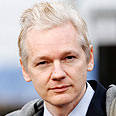
Marketing genius - Assange
צילום: רויטרס
The WikiLeaks bluff
Op-ed: Time has come to realize that WikiLeaks revelations have little bearing on real life
If you ever wondered what elected officials and servants do in their free time, the Israel-related WikiLeaks revelations provide an answer: They chatter themselves to death in conversations with American diplomats.
There isn't much else of use in the heaps of documents, and the time has come to puncture Julian Assange's PR balloon. We can select this odd man as the year's marketing genius, wish him a just trial in Sweden, and put things back in perspective.
Much of the WikiLeaks documents' appeal has to do with them being "classified" material that was "leaked out of the establishment." However, fundamentally they carry very little weight.
First and foremost, this has to do with this establishment's identity. The US State Department is a weakened body compared to the White House, the Pentagon, or the National Security Agency. The foreign office's finest hour was way back in the 1970s, when Secretary of State Henry Kissinger led, on behalf of President Richard Nixon, creative foreign policy in Southeast Asia, in the Middle East, and vis-à-vis the Soviet Union and China.
The Americans are not alone: We are dealing with an overwhelming global process where foreign services everywhere are declining. One reason for this is that in a world of satellites and Internet, with such huge progress in the realm of communications, the work of diplomats carries much less significance.
This is also true in respect to the American ambassador and his team, yet in Israel an invitation from the US embassy is still considered as one's heart's desire. Indeed, the list of dignitaries heading there, as exposed by WikiLeaks, is quite impressive: The chief justice, the chairman of the Histadrut labor union federation, our intelligence chiefs, settler leaders, and peace movement heads.
For some reason, ever since the publication of these documents, the notion reinforced is that participants in these talks shared their real worldviews, instead of the slogans they tend to sell to Israel's public. But why is that so? Were they connected to a polygraph while speaking? Who said reality isn't the exact opposite?
After all, we can argue that while sitting on the embassy's sofa, people tended to utter words that would satisfy their interlocutors, while portraying themselves in an enlightened and positive light.
Anyone ever invited to such conversation is familiar with the uniqueness of this occasion. A person is flattered when asked for his opinion in analyzing reality. Most people do not seek confrontation in such personal talks and tend to look for points of agreement. This is human nature. It's far from certain that this climate would give rise to the truth, and certainly not the whole truth.
When Yesha Council Chairman Danny Dayan sits there with the American ambassador, it's obviously more convenient to shun settler violence and show understanding for the evacuation of outposts. But even if we assume that these are Dayan's genuine views, what significance does this have in respect to results on the ground?
This is perhaps the main point about the WikiLeaks chatter. Humanity attributes exaggerated significance to talk. Moshe Dayan once said: Dead people are dead, while living people live. Inspired by that seemingly simplistic worldview, which was in fact incredibly deep, we can formulate another insight: The talkers talk, while the doers do.
The only thing that truly matters is action on the ground that creates or changes reality.
Not too long ago, Benjamin Netanyahu dramatically declared, first to German Chancellor Merkel and then to some eager journalists, that he will soon be delivering a "diplomatic speech," a sort of sequel to his Bar Ilan speech.
But who cares? And what exactly happened on the ground since the first Bar Ilan speech? Earlier, in the previous Knesset, Ehud Olmert delivered a "Churchillian speech," and then got entangled in a hasty, failed war in Lebanon.
The King's Speech, as successful and fascinating as it may be, is a historical film. Real life does not take place on the podium, at the American embassy, or in the virtual space of WikiLeaks.
- Follow Ynetnews on Facebook
