


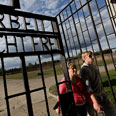
German concentration camp charges entry fee
Sachsenhausen camp begins charging €1 per visitor of commercially-organized tour groups. Site director: Money will go to additional tours
However on June 1, the Sachsenhausen concentration camp began charging €1 ($1.43) per visitor for all members of commercially-organized tour groups, according to a Der Spiegel report.
- Receive Ynetnews updates directly to your desktop
Politicians and tour organizers were quick to criticize the decision.
Tens of thousands of people were killed in Sachsenhausen, located 19 miles north of Berlin, during the Nazi regime. At first it was a concentration camp for political prisoners, holding some 200,000 people. Approximately 100,000 died there from sickness, malnutrition and medical experiments. After the war it became a Soviet prison camp.
According to Der Spiegel, the memorial site's director, Professor Günter Morsch, defended the decision saying it had been unanimously approved by the site's advisory and supervisory boards which include representatives of victims' associations, the national and regional governments, and the Central Council of Jews in Germany.
_wa.jpg)
A concentration camp survivor marks 65 years since release (Photo: Gettyimages)
Furthermore Morsch noted that the entrance to the site remains free of charge to individual visitors, survivors and their families and to students. He added that this estimated €20,000 to €30,000 (approx. $28,266 to $42,399) per year increase in income would be used to add more tours provided by the site.
"This is a public place financed by the taxpayer, and commercial firms are coming in and earning hundreds of thousands of euros here," Morsch said.
The tours provided by the site itself cost €15 ($21) per group of up to 15 people.
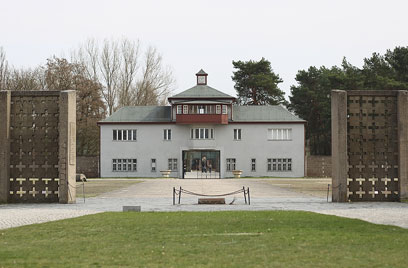
(Photo: Gettyimages)
Morsch mentioned that he has gotten a lot of complaints about the external guides. "Some guides try to fulfill visitors' expectations that Sachsenhausen is a kind of Auschwitz and conduct their tours accordingly," he claimed.
The German daily Süddeutsche Zeitung cited the president of the Central Council of Jews, Dieter Graumann, who criticized the move. "A concentration camp memorial site shouldn't create barriers for visitors," he said.
- Follow Ynetnews on Facebook
