


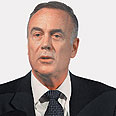
'This is final chord of free market era'
Disconcerting interview with consultant to global hedge funds Avi Tyomkin, who links the Israeli social protest to global processes. 'We're heading for a huge global nationalization wave of financial bodies. Presently, the private sector is the problem and governments are the solution'
Tyomkin paints a future far gloomier then the one he talked about in an interview to Calcalist in December 2008. In that interview, Tyomkin said "Europe is hurtling towards a calamity which will explode in the form of a recession deeper than in any other country in the world", he then claimed. "The European financial system will undergo sever crises and unemployment will climb as well."
In the current interview to Calcalist, Tyomkin takes a firmer stand and explains that the writing on the wall is not only for Europe but for the rest of the world as well, and that "we are about to witness the dawn of a new era on all accounts – economic, social and political."
He adds that "in contrast to the old world, the private sector is the new world's problem and governments are the solution. This shift will manifest in governments becoming increasingly involved in the market, including regulation, oversight on capital movements and more."
Tyomkin explained to Calcalist that in recent weeks, global markets have been writing off speculative rises that began on August 2010. "Investors believed that the various moves by governments and central banks would straighten out real economics but that just didn't happen." Furthermore, Tyomkin told Calcalist that if it were not for the power of developing economies, global indicators would be far worse."
'Not what real economic recovery looks like'
"The crisis in the Euro-zone periphery countries was not resolved – it just grew deeper. The markets thought it was just a matter of a temporary crisis in Greece that would end once Greece was bailed out but they failed to realize there was a crucial underlying chronic problem. The world turned a blind eye, and problems that persistently brewed under the surface where not dealt with in a satisfactory manner and were surely not solved."
Such as Europe's sovereign debt crisis?
"Among others, the banking system grave crisis in 2008 was real, and it wasn't solved – it was just put off. The best illustration of the banking system's predicament is Europe in which banks hardly made provisions for bad debt and there is almost a trillion Euros of debt and credit still listed in the banks' books in their full value."
Tyomkin notes that market rises between August 2010 and June this year were not generated by the public but by hedge funds or speculative investors. Now, says Tyomkin, the world is beginning to come to its senses. "In the days of market climbs, everyone thought that the worst was behind us and that the world economy will bounce back to its 2007 highs in as little as in two years."
But the lurking underneath the surface was a completely opposite truth," says Tyomkin. "Most of the world's wages were eroding, disposable income shrunk, global unemployment grew and quashed workers' claims for wage adjustments – all on the backdrop of unprecedented rises in food and commodity prices and especially in energy prices.
"Commercial banks still refuse almost categorically to use resources allotted to them by central banks and to grant credit to customers, house buyers and small to medium businesses. This refusal is justified for the most part since most potential lenders are insolvent. This is not what real economic recovery looks like."
What has been happening over the past several weeks that sparked the global panic?
"The first catalyst was the adjustment of growth figures for the first quarter of 2011 in the US to a miniscule annual 0.4% and to a minimal 1.3% growth rate for the second quarter of the year. This data indicates that the American economy is not really growing but rather shrinking.
"Another trigger that forced markets to reassess the world's recovery was the outbreak of the European debt crisis in Italy and Spain, which followed Greece, Portugal and Ireland. When Spain and Italy stepped into the picture, the world financial system was forced to realize that Germany alone could not pay the full price and is about to sustain the heaviest blow then any other country."
'US downfall will lead to full-scale global crash'
For the first time in history, the international rating agency downgraded the credit rating of the US from AAA to AA+.
"The downgrade reflects our opinion that the fiscal consolidation plan that Congress and the Administration recently agreed to falls short of what, in our view, would be necessary to stabilize the government's medium-term debt dynamics", stated the rating agency.
What are the implications of the US rating cut on financial markets?
"I don't see that it will significantly bear on the financial markets. We may expect a short-tem negative reaction on the markets, if at all; either way, there are not many alternatives in today's markets to US government bonds.
"Where is the world going to invest its money – in Greece? When S&P announced that it would lower the US rating last April, ten-year bond prices climbed and returns dropped by 1%. Eventually, the US government bond market which is worth 14 trillion dollars, is the only venue for solid, long-term investment."
Are there concerns that the US might go bankrupt?
"The answer is very simple", Tyomkin told Calcalist. "The US could always print more money to cover its debt. Moreover, the premises should be that the US will never become insolvent because due to the current global set-up and its total reliance on the US economy, the downfall of the US will lead to a full-scale global crash."
Tyomkin believes that the basic problems of global economy have yet to be resolved and that most of them have no solution. He points an accusing finger at policymakers who failed to comprehend the negative implications of the globalization, which introduced processes that albeit positive initially, proved to be a double-edged sword.
Tyomkin told Calcalist that the entrance of several countries to the western market – namely China and India – had a positive effect initially as cheap labor meant cheaper commodities for Western consumers, preventing an inflation outburst due to low wage levels. "This enabled banks to maintain a relatively low interest policy, and allow a boom in the stock, commodity, and real estate markets," explains Tyomkin.
"But then the countries that contributed to this process began experiencing wage pressures, especially China which today holds no relative advantage insofar as wage levels. At the same time, living standards in these countries climbed considerably and created unprecedented demand for various commodities particularly energy and food products, as well as pressure on commodity and oil prices."
'Globalization is in regression'
Tyomkin further explains, "Protectionism of local products and hiking import taxes and duties at that, is starting to rear its head once again in the trade war between countries and the abysmal conflict of interests among them. Globalization is in regression."
What will become of the financial markets?
"The commercial banking system's bad debt stock will grow considerably with the world slipping back into recession and the growing debt crisis in Europe. All of these will lead to the renewal of the banking crisis similarly to the one we experienced in 2008, and to growing involvement of governments in the markets. Governments will become the largest customer on the global market."
"The commercial banking system as we know it will be nationalized and serve as an agent of the central bank. I foresee an additional wave of nationalization in the world banking system, such as we witnessed at the end of 2008. The wave will entail the nationalization of financial bodies and insurance companies that will be unable to meet financial obligations. It is my estimate that the central bank of each country will remain the only operational bank that can grant credit."
Tyomkin told Calcalist reporter that the rapid processes that have occurred and that are still occurring all over the world – including in Arab countries – did not skip Israel. He claimed that the massive impact on global middle class purchasing power is affecting Israel's middle class as well.
"In recent years, the purchasing power in Israel has been drastically eroded while public sector and middle class wages have hardly increased."
Click here to read this report in Hebrew
- Follow Ynetnews on Facebook
