


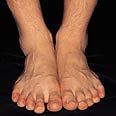
Keeping toenails healthy (illustration)
צילום: jupiter
Jewish podiatrist's revolutionary treatment
Health Canada approves laser treatment for fungal nails caused by skin infection
For years, fungal toenail infections lacked a treatment that could provide both safety and effectiveness. Finally, it appears that a new, revolutionary laser option is about to change that.
It is estimated that about 25% of the Canadian population suffers from one or more fungal nails in a lifetime, according to Dr. Hartley Miltchin, a podiatrist in Toronto who runs a private clinic called Accent on Feet.
Toenail fungus, also known as Onychomycosis, is generally caused by a skin infection commonly known as athlete’s foot.
Once contracted, usually in a public area such as a locker room or a swimming pool, the web area of the baby toe can start blistering and getting itchy. If left untreated, the infection may spread to the nearest toenail (usually the baby toenail).
From there, fungus grows from the top of the nail and works its way down. It can spread to all the adjacent nails and even to the nails on the other foot.
Fungal nails appear very discolored, usually turning yellow or brown. They become very thick and brittle and if left untreated, they can break open the skin and cause a secondary bacterial infection.
“A lot of people, especially women, become embarrassed to wear the shoes they choose to wear such as strappy sandals and flip flops because their nails are just so unsightly,” Miltchin tells Shalom Life.
“It’s estimated that 70% of podiatry patients exhibit fungal infections so it’s quite common. People can’t help but notice that they have a fungal infection on their nail because the nail becomes so deformed. It becomes so discolored and unmanageable.”
Miltchin says that if caught early, topical medications can be used to stop the infection from spreading, however they are only 10% effective. Once the infection spreads past the cuticle, oral medication would have to be used.
“The problem with oral medication is there is a distinct potential for liver damage,” said Miltchin, noting that while he has never encountered such a case, he stopped prescribing it years ago due to safety concerns.
“A lot of physicians, not only podiatrists but family doctors have stopped prescribing the medication because the risks can outweigh the benefits and they don’t want to subject their patients to it.”
In addition, the oral treatment is only 50 to 60% effective and the patient would have to take one tablet per day for four months.
“Anyone who treats fungal infections of the nails sort of has their hands tied because there hasn’t been an effective, safe treatment available until now.”
Miltchin is referring to the Cutera GenesisPlus laser system, which is based on a cosmetic device called the Nd:YAG 1064nm laser. When this laser is used, it penetrates at a certain depth, whether it is through skin or nails, and attacks the fungus both in the actual nail and underneath it.
Miltchin is the first and only podiatrist in Canada using this treatment, which was just recently approved by Health Canada. He was approached by Cutera, a very large, well-respected company in the cosmetic world, which asked him to help develop the protocols for the company’s new podiatric laser and perform clinical trials.
Since introducing the laser treatment to the Canada, Miltchin has seen excellent results.
“It’s a very fast, effective treatment. It takes about 20 minutes,” he said. “Usually only one treatment is required.”
The medication itself is painless, as patients will only feel some heating from the laser. For two weeks afterwards, Miltchin says to apply anti-fungal spray to the skin and anti-fungal liquid to the nails before bed, simply to help fight the infection.
“Results can be seen in approximately three to four months because nails grow very slowly. Full growth, especially in the big toe nails may take up to a year because of the growth cycle of the nail."
'Laser treatment does not equal a cure'
While results are not immediate, as Miltchin notes that it is usually a long process, the treatment is extremely effective. Contrary to the oral treatment, results of the laser technology are in the upper 90th percentile.
Perhaps just as importantly, there are no known side effects of the treatment, which has been in use in the Unites States for the past two years.
The laser can also be used to treat plantar warts, which is a virus that lives in the skin.
“It’s caught in the same ways; in public areas where there’s moisture or somebody may have a little crack in the skin and the virus invades,” he says.
“Plantar warts can become quite painful. Generally, the treatments available for plantar warts has been over-the-counter, drug store medications, which are all acid preparations that try to burn the wart out; liquid nitrogen which also burns the wart and even surgery to cut the wart out. But if there’s a lot of warts, you can’t really treat them effectively that way.”
Now, thanks to the laser, an effective treatment is finally available. The laser penetrates at a certain depth in the skin and elevates the virus allowing the wart to be eliminated in three to four weeks without the risk of scarring.
Miltchin says that it is important to remember that laser treatment does not equal a cure and that both fungal nail infections and warts can be contracted again.
“My analogy is that if you get strep throat and you take penicillin, it clears up the strep throat in about a week or ten days. It doesn’t mean that in the future, you’re not going to get strep throat again. It’s possible you will and you’ll have to take penicillin again. It’s the same thing with fungal infections.”
However, there are certain precautions people can take to avoid re-infection. Miltchin strongly recommends drying in between one’s toes and not just the feet following a bath or shower.
“Fungus loves warm, dark and moist environments, especially in between the toes. Shoes and socks are nice, dark and warm environments. It’s the perfect environment for fungus to grow and live.”
For those who sweat a lot, daily use of an over-the-counter, anti-fungal preparation, whether it be a powder or spray prior to putting on socks will help to prevent future infections.
For now, the treatment is only available in North America, but will soon be making its way over to Europe. Miltchin is excited to see the future of the laser.
“It’s revolutionary and finally there’s a treatment that’s available that’s effective.”
Reprinted with permission from Shalom Life
- Follow Ynetnews on Facebook
