



The journey to freedom
Special account by journalist who accompanied Shalit family for more than five years
I accompanied Aviva and Noam Shalit through more than five years and dozens of hours in conversations. When the terrible news arrived at the Shalit home in Mitzpe Hila, on June 25, 2006, Aviva was stunned and withdrew into herself. Noam, usually a distant man who greatly values his privacy, took on the role of family spokesman. On occasion, he would step out of the house to the journalists waiting outside, provide a succinct update and go back into the home.
- For full coverage of Gilad Shalit's homecoming click here
In the first days after the abduction, the Shalits were certain that Gilad would be returned within a short period of time, yet once the Second Lebanon War broke out the Shalit affair was cast aside, and nothing worked out after that.
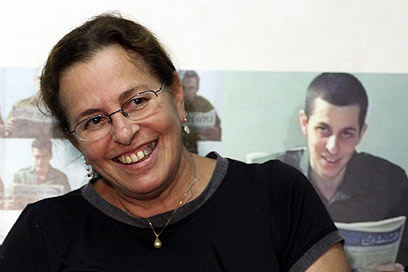
Aviva Shalit after hearing about the deal (Photo: EPA)
Noam kept telling me that the greatest difficulty is the uncertainty. He did not nag decision-makers, waiting for them to call and invite him to meetings. However, he eventually fully realized that the war for his son’s life is being managed via the media and that he better cooperate. When in one of my first stories I noted that he enlisted the help of a public relations agency, he called my angrily and asked where I got my information. Later he no longer hid the fact that he needs this kind of help.
Two years passed until Aviva opened her heart and her home to me. Only after she fully trusted me, asked questions and made inquiries, she agreed to submit to an interview. The first sentence she told me when I arrived in Mitzpe Hila early Saturday was: “I did not sleep the whole night. Mostly because of Gilad, but also because of the stress over the interview.”
A letter from captivity
Ever since that first interview, on every Shabbat and holiday I remembered her words; she told me that since the abduction the family does not hold birthdays, holidays or family dinners. Her son, Yoel, also spoke of the difficulty in coping with a family that is no longer whole. “In fact, I do not have a home that I can fully return to,” he said. “A home is the quiet, pleasant place you go back to. Yet here it’s the silence of absence.”
In May 2008, the Shalits received a letter from Gilad. “My situation is bad,” he wrote. “Don’t abandon me.” The pleas broke his mother, who could do nothing to save him. “A day doesn’t go by where I don’t think about the kind of conditions he is being held under, what he does there, what kind of food he receives and whether he sleeps. After a letter like this arrives, everything is much more extreme,” she said. “I of course imagine the possibility that this could be a Hamas manipulation, but this is Gilad’s handwriting and it’s very tough.”
In October 2009, a videotape of Gilad arrived. The family was unable to watch it again after the first time, when it saw the skinny child with the black circles under his sunken eyes. In her nightmares, Aviva saw one of Gilad’s captors taking his revenge on him after the IDF struck the captor’s home. Former captives made sure to maintain close ties with the family, spoke of the difficulties in returning from captivity, but stressed that it’s possible. Aviva clung to their words with all her might.

Aviva and Noam Shalit (Photo: Gil Yohanan)
Some two years ago, on Gilad’s 23rd birthday, his parents’ patience started to wear thin. “Every year they tell us that Gilad will be celebrating the holidays with us. These are empty words that make us nauseous,” Aviva told me with surprising harshness. “We’ve become cynical with the passage of time. Just like we won’t get back the same child we sent to the army, Gilad too will be getting different parents; more cynical and less accepting. We underwent some kind of change.”
When the negotiations hit a dead-end and concerns grew that Gilad will become the second Ron Arad, his parents decided to take off the gloves, head to Jerusalem and join the protest tent set up by Shalit campaign activists. Noam cast away his shyness and submitted to numerous interviews, while embracing and being photographed with anyone who asked for it. I saw the change, realizing it stemmed more from necessity rather than from an altered personality.
Psychological help
After Gilad spent 1,000 days in captivity, and with zero results, the frustrated family left the protest tent in Jerusalem and returned home. Aviva broke. In a moment of confession she told me that she had to enlist the help of a psychologist offered by the Defense Ministry in order to cope with the difficulties. She overcame the crisis after several meetings and has not sought professional help since.
Benjamin Netanyahu’s election win inspired hope in the Shalits, yet quickly came the painful sobriety. “Netanyahu speaks very well, makes promises but brings no results,” Gilad’s brother, Yoel, told me. Netanyahu’s objection to a Shalit swap prompted the family to agree to embark on a journey from Mitzpe Hila to Jerusalem in the summer of 2010. Aviva and Noam, who up until that time worked part-time, left their jobs and decided to stay in Jerusalem until Gilad’s return. During the year-and-a-half they spent in the capital, Aviva wanted to return home several times, Yet Noam refused and they stayed.

Celebrating in Mizpe Hila (Photo: Reuters)
In recent months, Aviva found an outlet in knitting, her eyes fixed on the yarn instead of on the people. She characterized knitting as an escape from the glaring stares and repeated questions. She also ignored the good-natured words of advice urging her to add God’s initial to Gilad’s name or put her faith in blessings. For her, the key to her son’s freedom was in Netanyahu’s hands, not in God’s.
In August of this year, ahead of Gilad’s 25th birthday, I accompanied the Shalits for a week at the Jerusalem tent. Aviva arrived at the last interview with a sheet of paper where she wrote down points she thought were important. “For half a decade I’ve been asking myself why this is happening to Gilad and what he did wrong. He’s the purest thing, it’s impossible that someone wanted to punish him,” she told me painfully. It was difficult to continue the conversation after that.
The next day she told me that the whole night she thought about the trees in their backyard, which have been waiting for five years for Gilad to return and trim them, as he did in the past. Now that Gilad is back home and can trim the treetops, the Shalits are finally able to tightly embrace their lost son and from the balcony of their home in Mitzpe Hila look at the sea and open horizon, without anything hiding away the light.
- Follow Ynetnews on Facebook
- Receive Ynetnews updates directly to your desktop
