


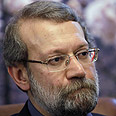
'We'll punish Zionists for murdering scientist'
Iranian official says 'Zionist regime should be punished in a way that it can not play such games with our country again'
An ally of Iran's supreme leader called on Friday for Israel to be "punished" for killing a nuclear scientist last week.
After Supreme Leader Ayatollah Ali Khamenei paid his respects to the families of two scientists assassinated on what Tehran believes were Israel's orders, one of them just last week, a close ally who is a former nuclear negotiator and currently speaker of parliament demanded retribution.
Related stories:
- Netanyahu: Iran sanctions ineffective Obama: Iranian economy in 'shambles' 'Sanctions not only option against Iran'
"Terrorism has a long history in some countries like the Zionist regime," Ali Larijani said of Israel, which views an atomic bomb in the hands of the Islamic Republic as a threat to the survival of the Jewish state.
"The Zionist regime should be punished in a way that it can not play such games with our country again."
Israel has denied accusations that it deployed the hit squad which blew up Mostafa Ahmadi-Roshan on a busy Tehran street last week. But the country has a record of such attacks and is widely presumed by Western analysts to be engaged, along with allies, in a covert war against a nuclear development program which Iran insists is entirely civilian.
'Coordinate strategy'
Sharp US disavowal of American involvement in the killing have drawn some analysts to see it as a form of rebuke to Israel, amid speculation that President Barack Obama is wary, while he campaigns for re-election in November, that Israel could launch unilateral action that might inflame the region.
Obama's top military official, chairman of the Joint Chiefs of Staff General Martin Dempsey, paid a brief visit to Israel and was quoted by its Defense Ministry as telling officials there that Washington was keen to coordinate on strategy.
"We have many interests in common in the region in this very dynamic time and the more we can continue to engage each other, the better off we'll all be," Dempsey was quoted as saying in a statement issued by the ministry.
Renew negotiations?
Meanwhile, major powers seeking to negotiate an end to Iran's suspected pursuit of nuclear weapons on Friday signaled their openness to renewed talks with Tehran but diplomats said the powers remain divided on their approach.
EU foreign policy Chief Catherine Ashton, who represents the group, issued a statement making clear that a diplomatic path remains open to Iran despite tougher sanctions and fresh speculation of a military strike on its nuclear facilities.
The group, known as the P5+1 and as the EU3+3, includes Britain, China, France, Germany, Russia and the United States.
"The EU3+3 has always been clear about the validity of the dual track approach," Ashton's spokesperson said in a statement that included her Oct. 21 letter. "We are waiting for the Iranian reaction."
But a member of Iran's national security and foreign policy committee, was quoted by the semi-official Fars news agency as saying on Friday that using the P5+1 to discuss the nuclear issue was unacceptable.
"Iran will on no account attend the negotiations if the P5+1 is looking to make any comments on Iran's nuclear activities or wants to make any decision about that," Hossein Naqavi said, repeating however Tehran's willingness to cooperate with the UN's International Atomic Energy Agency.
- Receive Ynetnews updates directly to your desktop
