


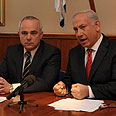
Steinitz: Early ballot won't shake economy
Finance minister says Israel's financial stability will be maintained in 2013, despite elections called after government fails to agree on budget
"In July ... half the budget, the revenue side of it, was already passed, in order to make sure ahead of time that if the (full) budget is not passed, that revenue, deficit and financial stability will be preserved in 2013," Steinitz told Army Radio.
Prime Minister Benjamin Netanyahu announced on Tuesday that he would seek an early election after he was unable to agree with his coalition partners over proposed cuts in the 2013 budget.
Parliament will dissolve itself in the coming days and fix the election date, with Netanyahu in charge of a transitional government until a new administration is sworn in. The vote is likely to be held in late January.
Steinitz said that in the first few months of 2013, the government would continue working with the 2012 budget, taking a 12th of it monthly until a new budget is passed.
"The election will probably be held in January. I presume that in February, Benjamin Netanyahu will have formed his new government and by March or April there will already be a new budget," Steinitz said.
Netanyahu has been under pressure from Israel's central bank to maintain fiscal credibility at a time when the economy is slowing and tax revenues are falling short.
The cabinet approved a package of tax hikes and spending cuts in July, measures the Finance Ministry had said would add NIS 14.4 billion (about $3.7 billion) to state coffers next year.
In an interview with Reuters last month, Steinitz said the 2013 budget calls for NIS 10-14 billion ($2.6-3.6 billion) worth of cuts in order to reach a 3% of GDP deficit target.
Israel's economy weathered the global economic crisis well until a year ago, when exports began to slow as a result of downturns in Europe and the United States, its two largest trading partners.
Exports account for about 40% of Israel's economic activity. The central bank forecast in September the economy would grow 3% in 2013, down from an estimate made in June of 3.4%.
