



Shulamit Aloni: Savior of the haredim
Op-ed: The change taking place in the ultra-Orthodox sector in recent years was motivated by the woman the haredim loved to hate
Unlike many politicians, Aloni had one great virtue, which some would say was what angered the haredi public so much: She was a consistent person, who said what she meant. She never zigzagged in order to promote her agenda. She really and truly didn't like the haredi conduct. She really loathed the connection between religion and state, which was too tight in her opinion, and saw faith in God as unnecessary and fanatic.
And yet in the past few years, at least one of Aloni's utopias is taking shape, an actual reality – and this is only one of the fascinating phenomena the young haredi public is going through: Massively joining the world of labor, and a significant rise in the number of haredi students in the academia. Haredi colleges, alongside "kosher" campuses and courses adjusted to the sector, are popping up every now and then in order to catch up with the high demand.
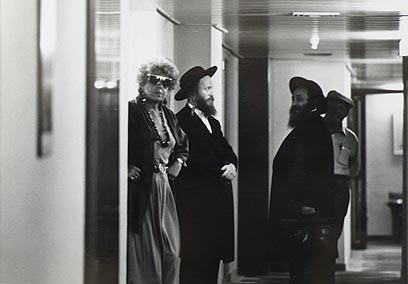
What began as a drizzle about a decade ago has turned into an unstoppable flow. The status of the haredi woman has also undergone a fascinating transformation: Haredi girls have become fed up with the traditional profession of teaching, and have moved to study free professions in the fields of high-tech, accounting and more. A significant number of them develop a career and even, Heaven forbid, buy a car before getting married.
The woman who motivated the sector
How did such a significant change take place in the remarkably conservative society which has devoted itself almost exclusively to Torah study? The natural growth of the haredi public, which could no longer contain such a large and yet such a poor public of students, had a role in the revolution.
But these natural processes required a catalyst. The "trigger" can be seen today in Shulamit Aloni's image. The right of priority in the discourse which some call "anti-haredi," and some call "egalitarian," belongs to her. Her role as education minister, which stirred up so many against her from the haredi direction, was one of the catalysts which led to the change, in a sort of chain reaction in what is known in sociology lingo as "the society of learners."
In the early 1990s, Aloni sought to create internal changes in the haredi society. I have no doubt that shutting down the Religious Affairs Ministry by Lapid's Shinui party, and Netanyahu's "austerity measures" as finance minister, are an outcome of that initial motivation.
The former Meretz chairwoman's harsh statements against religion and its believers were sometimes distasteful and angered many in the sector. Nonetheless, this intervention, and the inelegant way Aloni waged the battle, created the change in the haredi society.
During Shulamit Aloni's days in Meretz, and even before that in Ratz, she outraged the haredim down to the very last of them; got the sector's weakest links moving; created an agenda; and set in motion discussions which pushed for the creation of the haredi academia and labor market.
The haredi public is still at odds over these core issues, but whichever way you look at it, Aloni wrote a significant chapter in the sector's history, the consequences of which are an entire book.
